Salesforce service workflow orchestration
Service Workflow Orchestration for Salesforce
Coordinate every case from arrival to resolution. Ortoo Orchestrator turns incomplete or unstructured requests into governed service workflows, capturing the right information, triaging and routing each case, monitoring SLA risk and escalating before delays become breaches.
- 100% Salesforce native
- Every decision logged
- AI only where you configure it
- Per-work-item pricing
FREE TOOL
See what faster case resolution could recover for your team
Estimate the capacity orchestration could recover for your team.
'%20id='layer1'%3e%3cpath%20d='M%20372.07821,531.63637%20L%20372.07821,530.40262%20L%20367.33659,530.40262%20C%20365.00484,530.40262%20363.91609,531.20162%20363.91609,532.43762%20C%20363.91609,533.57087%20364.96609,534.57162%20367.64846,534.57162%20C%20370.95121,534.57162%20372.07821,534.2705%20372.07821,531.63637%20z%20M%20361.93559,523.36912%20L%20360.26259,525.05662%20C%20358.70596,524.12187%20357.11284,523.48812%20354.97484,523.48812%20C%20352.44846,523.48812%20351.59384,524.35537%20351.59384,525.52312%20C%20351.59384,526.25675%20352.21559,526.9905%20354.19721,527.12475%20L%20357.46246,527.32362%20C%20359.47721,527.43875%20360.89334,528.017%20361.81371,528.89712%20C%20362.88834,527.97975%20364.48659,527.39612%20366.59834,527.39612%20L%20372.07821,527.39612%20L%20372.07821,525.67425%20C%20372.07821,524.07262%20370.87359,523.50525%20368.03571,523.50525%20C%20365.97659,523.50525%20364.63221,524.11237%20363.59509,525.069%20L%20361.93559,523.36912%20z%20M%20391.42271,527.65687%20L%20400.58646,527.65687%20C%20400.58646,524.72437%20398.40484,523.26912%20395.98771,523.26912%20C%20393.57196,523.26912%20391.42271,524.69825%20391.42271,527.65687%20z%20M%20377.70559,528.94887%20C%20377.74184,531.714%20377.78584,532.1495%20378.50521,532.92425%20C%20379.06559,533.53012%20380.28059,534.2385%20381.92259,534.2385%20C%20383.52321,534.2385%20384.56346,533.53012%20385.12571,532.92425%20C%20385.84584,532.1495%20385.92671,531.67812%20385.92671,528.94887%20C%20385.92671,526.187%20385.84584,525.714%20385.12571,524.94062%20C%20384.56346,524.33437%20383.52321,523.62625%20381.92259,523.62625%20C%20380.28059,523.62625%20379.06559,524.33437%20378.50521,524.94062%20C%20377.78584,525.714%20377.66809,526.16462%20377.70559,528.94887%20z%20M%20375.21084,522.85987%20C%20375.33771,522.6965%20375.47934,522.53275%20375.63596,522.35687%20C%20376.52871,521.38975%20378.28009,520.28987%20380.84346,520.28987%20C%20382.86584,520.28987%20384.46009,520.95662%20385.93646,522.29087%20L%20385.93646,520.48937%20L%20389.89971,520.48937%20L%20389.89971,522.34262%20C%20391.47184,520.86625%20393.58496,520.28987%20395.56209,520.28987%20C%20399.89746,520.28987%20403.63109,523.26037%20403.65434,528.25212%20C%20403.65959,529.10612%20403.55859,530.63237%20403.55859,530.63237%20L%20391.41759,530.63725%20C%20391.41759,533.3955%20393.29896,534.43675%20396.01234,534.43675%20C%20397.52109,534.43675%20399.43809,533.7465%20400.60059,532.71825%20L%20403.26034,534.65%20C%20401.32271,536.57712%20398.72184,537.62675%20396.08796,537.62675%20C%20393.92134,537.62675%20391.59221,537.1195%20389.89971,535.5755%20L%20389.89971,537.00012%20C%20389.89971,542.10375%20385.85746,544.43812%20381.35059,544.43812%20C%20378.82359,544.43812%20376.25771,543.30325%20374.50896,541.603%20L%20377.57871,539.50237%20C%20378.55184,540.33562%20379.91171,541.03625%20381.42696,541.03625%20C%20384.07059,541.03625%20385.93646,539.73562%20385.93646,537.367%20L%20385.93646,535.63275%20C%20384.69284,536.7995%20382.86584,537.60012%20380.84346,537.60012%20C%20378.62496,537.60012%20377.01596,536.77637%20376.04284,535.92712%20L%20376.04284,537.64287%20L%20372.07821,537.64287%20L%20372.07821,535.91425%20L%20372.00221,535.91425%20C%20371.18546,537.082%20369.82484,537.61537%20367.14284,537.61537%20C%20364.63609,537.61537%20362.72621,536.88762%20361.54646,535.71787%20C%20360.06971,536.937%20357.71734,537.597%20355.01434,537.597%20C%20351.82671,537.597%20348.87196,536.59612%20346.34546,534.56237%20L%20349.10484,532.22775%20C%20350.81484,533.66012%20352.68009,534.3965%20355.32459,534.3965%20C%20357.58021,534.3965%20359.21121,533.66012%20359.21121,532.22775%20C%20359.21121,531.026%20358.16246,530.6595%20356.80121,530.55925%20L%20353.30309,530.29262%20C%20350.03846,530.05937%20347.62846,528.39125%20347.62846,525.49025%20C%20347.62846,522.05412%20350.81484,520.28625%20354.97484,520.28625%20C%20357.97946,520.28625%20360.13284,520.96612%20361.92084,522.06187%20C%20363.37121,520.76212%20365.27596,520.304%20367.84184,520.304%20C%20371.26109,520.304%20373.92921,520.99762%20375.21084,522.85987'%20style='fill:%23008066;fill-opacity:1;fill-rule:nonzero;stroke:none'%20id='path2489'%20/%3e%3c/g%3e%3c/svg%3e)









%20--%3e%3csvg%20xmlns:svg='http://www.w3.org/2000/svg'%20xmlns='http://www.w3.org/2000/svg'%20version='1.0'%20width='800'%20height='110.066'%20viewBox='0%200%20800%20110.066'%20id='svg2'%20xml:space='preserve'%3e%3cdefs%20id='defs23'%20/%3e%3cg%20style='display:none'%20id='Grade'%3e%3c/g%3e%3cg%20id='Camada_1'%3e%3c/g%3e%3cg%20id='Área_de_trabalho'%3e%3c/g%3e%3cg%20id='Linhas-guia'%3e%3c/g%3e%3cg%20id='Page_1'%3e%3cg%20id='Camada_1_1_'%3e%3cg%20id='g10'%3e%3cpolygon%20points='0,4.723%200,19.33%2023.959,19.33%2070.846,107.261%20128.543,107.261%20175.43,19.184%20199.385,19.033%20199.437,4.723%20127.761,4.723%20127.761,19.083%20146.849,19.083%20113.74,81.595%2077.933,19.301%20104.05,19.184%20104.004,4.723%200,4.723%20'%20style='fill:%230d3896;fill-rule:evenodd'%20id='polygon12'%20/%3e%3cpolygon%20points='462.405,4.723%20462.405,19.33%20486.357,19.33%20533.245,107.261%20590.944,107.261%20637.831,19.184%20661.789,19.033%20661.832,4.723%20590.169,4.723%20590.169,19.083%20609.249,19.083%20576.141,81.595%20540.33,19.301%20566.455,19.184%20566.406,4.723%20462.405,4.723%20'%20style='fill:%230d3896;fill-rule:evenodd'%20id='polygon14'%20/%3e%3cpath%20d='M%20344.515,4.723%20L%20344.515,19.33%20L%20368.47,19.33%20L%20368.51,91.118%20L%20343.255,91.118%20L%20343.255,107.119%20L%20368.527,107.262%20L%20488.139,107.262%20L%20488.139,59.532%20L%20472.558,59.532%20C%20471.704,84.803%20449.782,91.152%20440.548,91.152%20C%20432.087,91.152%20415.693,91.119%20415.693,91.119%20L%20415.693,19.301%20L%20439.288,19.183%20L%20439.256,4.722%20L%20344.515,4.722%20L%20344.515,4.723%20z%20'%20style='fill:%230d3896;fill-rule:evenodd'%20id='path16'%20/%3e%3cpath%20d='M%20262.808,94.13%20C%20248.453,94.13%20236.822,76.935%20236.822,55.713%20C%20236.822,34.486%20248.453,17.278%20262.808,17.278%20C%20277.159,17.278%20288.794,34.486%20288.794,55.713%20C%20288.794,76.935%20277.159,94.13%20262.808,94.13%20L%20262.808,94.13%20z%20M%20263.864,1.777%20C%20223.144,1.777%20190.135,26.024%20190.135,55.922%20C%20190.135,85.822%20223.143,110.066%20263.864,110.066%20C%20304.581,110.066%20337.595,85.822%20337.595,55.922%20C%20337.595,26.024%20304.581,1.777%20263.864,1.777%20L%20263.864,1.777%20z%20'%20style='fill:%230d3896;fill-rule:evenodd'%20id='path18'%20/%3e%3cpath%20d='M%20725.215,93.857%20C%20710.865,93.857%20699.235,76.377%20699.235,54.804%20C%20699.235,33.239%20710.866,15.755%20725.215,15.755%20C%20739.567,15.755%20751.195,33.239%20751.195,54.804%20C%20751.196,76.376%20739.567,93.857%20725.215,93.857%20L%20725.215,93.857%20z%20M%20726.276,0%20C%20685.547,0%20652.548,24.642%20652.548,55.028%20C%20652.548,85.413%20685.546,110.05%20726.276,110.05%20C%20766.99,110.05%20800,85.413%20800,55.028%20C%20800,24.642%20766.99,0%20726.276,0%20L%20726.276,0%20z%20'%20style='fill:%230d3896;fill-rule:evenodd'%20id='path20'%20/%3e%3c/g%3e%3c/g%3e%3c/g%3e%3c/svg%3e)
Service workflow orchestration that coordinates the whole case
Most customer service automation handles an individual task, such as creating a case, assigning it to a queue or sending an automated response. Service workflow orchestration coordinates those tasks as one governed process spanning intake, triage, routing, escalation and resolution. Ortoo Orchestrator connects the existing Salesforce automation, people, AI and external services involved in the case while logging each workflow decision against the Salesforce record.
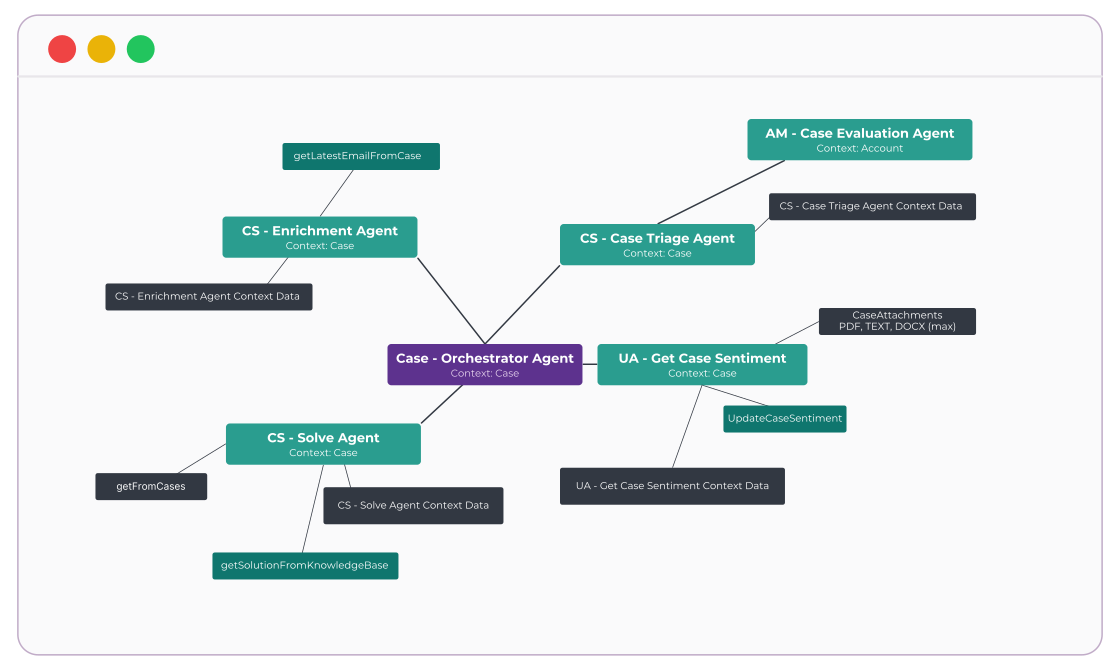
The service tools work. The case still breaks between them.
Service Cloud, Flow, Omni-Channel, Email-to-Case and AI each provide valuable capabilities. Operational gaps appear when no workflow coordinates what should happen between intake, interpretation, assignment, escalation and resolution. Cases wait for manual review, move between teams and lose clear ownership. Ortoo Orchestrator governs those transitions as one connected service workflow.
Triage and routing on arrival
An inbound case may initially contain little structured information about its topic, urgency, customer context or required expertise. Ortoo Orchestrator can use approved AI steps to classify and prioritise the request, then apply deterministic routing criteria including skills, capacity, availability, customer tier and SLA.
Escalation before the SLA breaks
Cases should not share the same escalation path regardless of urgency, customer commitment or operational risk. Ortoo Orchestrator assigns the appropriate priority and SLA conditions, monitors progress and triggers configured escalations before a breach occurs, including reassignment or cover when an agent is unavailable.
Routine service requests handled through governed automation
Repeatable requests can consume experienced-agent capacity even when the required outcome is predictable. Ortoo Orchestrator classifies the request and coordinates the configured response, resolution or routing path, while directing uncertain or higher-risk cases to human review.
Governed email intake across Salesforce records
Salesforce Email-to-Case provides native case creation from inbound email. Ortoo extends email-driven service workflows by capturing messages into the appropriate standard or custom Salesforce record, maintaining the conversation thread and coordinating classification, routing and subsequent replies as part of the wider workflow.
Service automation executes tasks. Workflow orchestration coordinates the case.
Salesforce Flow executes configured automation. Omni-Channel distributes supported work. Email-to-Case captures inbound email. AI can interpret unstructured information. Ortoo Orchestrator coordinates those capabilities across the complete service workflow.
Salesforce provides powerful service automation capabilities. Orchestration becomes valuable when a case spans multiple automations, routing decisions, people, systems, waiting states and exceptions that must operate as one governed process.
| Automation | Orchestration |
|---|---|
| Executes an individual task | Coordinates the complete case workflow |
| Creates or assigns the case | Governs progression from intake to resolution |
| Runs one Flow or routing action | Coordinates Flows, routing, AI and people |
| Responds to a defined trigger | Maintains responsibility for what happens next |
| Records one automation result | Provides visibility across the complete execution path |
Automation
Executes an individual task
Orchestration
Coordinates the complete case workflow
Automation
Creates or assigns the case
Orchestration
Governs progression from intake to resolution
Automation
Runs one Flow or routing action
Orchestration
Coordinates Flows, routing, AI and people
Automation
Responds to a defined trigger
Orchestration
Maintains responsibility for what happens next
Automation
Records one automation result
Orchestration
Provides visibility across the complete execution path
Ortoo Orchestrator is the service workflow orchestration layer. Existing Salesforce Flows, Email-to-Case processes, Omni-Channel configurations, routing logic and approved AI capabilities can operate as governed stages within the complete case workflow. See how workflow automation and orchestration differ.
What service workflow orchestration changes day to day
From intake and triage through routing, escalation and resolution, Ortoo Orchestrator coordinates the operational steps that otherwise depend on manual review and follow-up. Each action becomes part of one governed Salesforce workflow, with decisions and outcomes logged against the case record.
Inbound email, web forms, chat and portal submissions become structured Salesforce records. Approved extraction and classification steps populate the required fields from the request and its attachments, reducing the time agents spend interpreting and manually recording inbound work.
Email-to-case orchestrationWhat changes day to day.
Routing reflects the case and current operational conditions.
Cases reach eligible agents using configured skills, capacity, availability, priority and customer criteria.
Queue pressure becomes visible and manageable.
Work progresses according to priority, SLA and configured service policy rather than simple arrival order.
SLA risk becomes visible before service commitments are missed.
Escalation follows configured time, risk, priority and ownership conditions.
Exceptions follow a defined review and recovery path.
Reassignment, escalation and human review occur through governed workflow logic.
Experienced agents focus on cases that require judgement.
Classification, prioritisation and routing can begin as soon as the case arrives.
Cost stays predictable.
You pay for work completed, not the steps required to complete it.
Salesforce-native service orchestration with a complete audit trail
Ortoo Orchestrator runs natively inside Salesforce using the existing data, permissions and automation model. Salesforce remains the system of record. Every classification, routing decision, escalation and workflow action is logged against the relevant case. When a service workflow requires an external system, knowledge source or AI model, it can be invoked as a governed step using the customer's approved provider and API key.
Service workflow orchestration layer
Ortoo Orchestrator
Salesforce Service Cloud
Cases, queues, rules, Email-to-Case, Omni-Channel, flows
Connected service capabilities
Support platforms, AI providers, knowledge bases, analytics
Define the service outcome. Orchestrate how each case reaches it.
Define the intended service outcome and the stages required to reach it. Ortoo Orchestrator coordinates intake, triage, routing, escalation and resolution as one governed sequence. Service operations teams can adjust configured workflow logic as case types, staffing models and service policies change, within the controls established by Salesforce and platform administrators.
Triage this case and assign to the right specialist.
Use AI to interpret the case. Keep service decisions governed.
AI is useful when a service workflow must interpret unstructured content, classify a request, assess sentiment or summarise a long conversation. Deterministic logic remains better suited to fixed routing constraints, SLA policy, escalations, approvals and ownership decisions. \n\n\nOrtoo Orchestrator allows teams to activate AI only at the stages where interpretation adds value, constrain outputs to controlled values and log every AI-assisted action against the Salesforce case. Customers can use an approved model with their own API key.
Classify this case and tag the right product area.
Ortoo Orchestrator supports any LLM provider.
Service in action: Sage Intacct
Sage Intacct's customer support operation handles over 40,000 cases annually, with 10-15% year-over-year growth. The team needed case automation that could scale beyond manual triage and assignment, without scaling headcount in proportion.
The challenge
- Case volumes growing 10-15% per year across multiple product lines and customer tiers
- Manual triage consuming senior-agent time at the expense of resolution capacity
- Complex case distribution requirements that Salesforce native routing could not handle
- Dynamic case actions, instructions to case owners and managers, required custom Flow or Apex to build and maintain
The impact
- 50% faster case resolution
- 55% improvement in case deflection
- Workflow now provides dynamic instructions to case owners and managers under configured conditions
- Service operation scales to growing case volumes without proportional headcount growth
“Ortoo has helped us to take case automation to even greater levels. We started the year talking about dynamic actions as a concept, and ended it as a reality where the workflow is now not only assigning cases, but also providing instructions to the case owners and managers under various conditions.”
Anthony Johnson, Customer Support Operations Director, Sage Intacct
When case volume outgrows disconnected service automation, workflow orchestration produces measurable improvements.
Rapid7
SLA-aware routing and proactive escalation for a global security operation handling complex case workloads.
Read the case studySplunk
International service routing across multiple locations, for a team that previously could not offer round-the-clock coverage.
Read the case studyEquativ
Fair workload distribution across agents, with multiple factors weighed together. SLA compliance moved from target to result.
Read the case studyRelated pages
Salesforce Case Management
Manage the complete case lifecycle from intake and ownership through escalation, resolution and closure.
Read moreSalesforce Case Routing
Evaluate and route cases using skills, capacity, availability, priority and SLA criteria.
Read moreSalesforce Case Orchestration
Coordinate case intake, triage, routing, escalation and resolution as one connected execution path.
Read moreSalesforce email management for service teams
High-volume email-to-case as a single workflow.
Read moreSalesforce Email-to-Case with AI triage
AI-driven case intake and triage on top of native Email-to-Case.
Read moreRevenue workflow orchestration
Companion solution for lead, opportunity, and territory workflows.
Read moreSalesforce Case Management
Govern the complete case lifecycle, including ownership, escalation, handoffs, resolution and closure.
Read moreCase assignment in Salesforce
Multi-factor case assignment inside the lifecycle.
Read moreQ-Assign
Assignment engine that powers the routing step.
Read moreService workflow orchestration: common questions
What is service workflow orchestration in Salesforce?
Service workflow orchestration coordinates the Salesforce records, Flows, routing logic, AI capabilities, service agents and external systems involved in an end-to-end case process. Customer service automation executes individual tasks. Orchestration governs how those tasks connect, what should happen next, who owns each stage and how exceptions or SLA risks are handled.
What is the difference between customer service automation and service workflow orchestration?
Customer service automation completes defined tasks such as creating a case, assigning work or sending a response. Service workflow orchestration coordinates those tasks across the complete case lifecycle. It governs sequence, ownership, dependencies, waiting states, escalations and exceptions so that separate automations contribute to one service outcome.
What is the difference between service workflow orchestration and case routing?
Case routing determines which queue, team or agent should receive a case. Service workflow orchestration governs the broader process around that decision, including intake, classification, prioritisation, assignment, SLA monitoring, escalation, resolution and closure. Routing is one stage within the complete service workflow.
How does this work alongside Salesforce Omni-Channel?
Salesforce Omni-Channel distributes supported work to available agents using configured presence, capacity and routing settings. Ortoo Orchestrator can coordinate the stages before and after that distribution and add advanced assignment through Q-assign where the workflow requires additional criteria such as skills, customer context, workload, SLA or operational exceptions. Existing Omni-Channel configurations can remain in place.
Does this work with Salesforce Service Cloud?
Yes. Ortoo Orchestrator runs natively inside Salesforce and works with the existing Service Cloud data, records, permissions and automation model. Salesforce remains the system of record, and workflow decisions and actions are logged against the relevant case or service record.
How does Ortoo Orchestrator work alongside Salesforce Flow?
Salesforce Flow remains a powerful automation capability for executing defined actions and record-based logic. Ortoo Orchestrator coordinates Flows, routing, approvals, AI services, external systems and human work across a longer-running service process. Existing Flows become governed stages within the workflow rather than needing to be replaced.
What AI is included, and how is it governed?
AI-enabled workflow steps can support activities such as case classification, content extraction, sentiment assessment and conversation summarisation. AI is activated only where configured and can return controlled values rather than unrestricted output. Routing, SLA, escalation and ownership rules can remain deterministic. Customers use an approved model with their own API key, and each workflow action is logged against the Salesforce record.
How long does it take to get one service workflow running?
Implementation depends on the service process, existing Salesforce configuration and connected systems. The recommended approach is to begin with one clearly defined workflow, such as inbound case triage, SLA-aware routing or escalation, validate it using real case volume and then expand to additional processes. Confirm the expected scope with the Ortoo team for the specific use case.
Does service workflow orchestration replace Salesforce Service Cloud?
No. Ortoo Orchestrator runs inside Salesforce and extends the existing Service Cloud environment. It coordinates Service Cloud records, Flows, queues, routing configurations, people, AI and external services as one governed workflow while Salesforce remains the system of record.
See where your service workflow gets stuck
Bring one case workflow. We will map how it runs today and identify where connected orchestration can reduce manual triage, repeated reassignment, SLA risk and escalation failures.
Installs natively into Salesforce. Start with one workflow, expand to others as the team is ready. You pay for work completed, not the steps required to complete it.