Salesforce revenue workflow orchestration
Revenue Workflow Orchestration for Salesforce
Revenue workflows stall between automated steps. Leads wait, opportunities sit with the wrong owner, and follow-ups depend on someone remembering. Salesforce Flows, assignment rules and round-robin processes automate individual actions, but they don't coordinate the complete revenue process. Ortoo Orchestrator coordinates the revenue workflow end-to-end inside Salesforce.
- 100% Salesforce native
- Multi-factor routing
- No cherry-picking
- Per-work-item pricing
FREE TOOL
See what this is worth across your lead and opportunity volume
Estimate the capacity orchestration could recover for your team.
'%20id='layer1'%3e%3cpath%20d='M%20372.07821,531.63637%20L%20372.07821,530.40262%20L%20367.33659,530.40262%20C%20365.00484,530.40262%20363.91609,531.20162%20363.91609,532.43762%20C%20363.91609,533.57087%20364.96609,534.57162%20367.64846,534.57162%20C%20370.95121,534.57162%20372.07821,534.2705%20372.07821,531.63637%20z%20M%20361.93559,523.36912%20L%20360.26259,525.05662%20C%20358.70596,524.12187%20357.11284,523.48812%20354.97484,523.48812%20C%20352.44846,523.48812%20351.59384,524.35537%20351.59384,525.52312%20C%20351.59384,526.25675%20352.21559,526.9905%20354.19721,527.12475%20L%20357.46246,527.32362%20C%20359.47721,527.43875%20360.89334,528.017%20361.81371,528.89712%20C%20362.88834,527.97975%20364.48659,527.39612%20366.59834,527.39612%20L%20372.07821,527.39612%20L%20372.07821,525.67425%20C%20372.07821,524.07262%20370.87359,523.50525%20368.03571,523.50525%20C%20365.97659,523.50525%20364.63221,524.11237%20363.59509,525.069%20L%20361.93559,523.36912%20z%20M%20391.42271,527.65687%20L%20400.58646,527.65687%20C%20400.58646,524.72437%20398.40484,523.26912%20395.98771,523.26912%20C%20393.57196,523.26912%20391.42271,524.69825%20391.42271,527.65687%20z%20M%20377.70559,528.94887%20C%20377.74184,531.714%20377.78584,532.1495%20378.50521,532.92425%20C%20379.06559,533.53012%20380.28059,534.2385%20381.92259,534.2385%20C%20383.52321,534.2385%20384.56346,533.53012%20385.12571,532.92425%20C%20385.84584,532.1495%20385.92671,531.67812%20385.92671,528.94887%20C%20385.92671,526.187%20385.84584,525.714%20385.12571,524.94062%20C%20384.56346,524.33437%20383.52321,523.62625%20381.92259,523.62625%20C%20380.28059,523.62625%20379.06559,524.33437%20378.50521,524.94062%20C%20377.78584,525.714%20377.66809,526.16462%20377.70559,528.94887%20z%20M%20375.21084,522.85987%20C%20375.33771,522.6965%20375.47934,522.53275%20375.63596,522.35687%20C%20376.52871,521.38975%20378.28009,520.28987%20380.84346,520.28987%20C%20382.86584,520.28987%20384.46009,520.95662%20385.93646,522.29087%20L%20385.93646,520.48937%20L%20389.89971,520.48937%20L%20389.89971,522.34262%20C%20391.47184,520.86625%20393.58496,520.28987%20395.56209,520.28987%20C%20399.89746,520.28987%20403.63109,523.26037%20403.65434,528.25212%20C%20403.65959,529.10612%20403.55859,530.63237%20403.55859,530.63237%20L%20391.41759,530.63725%20C%20391.41759,533.3955%20393.29896,534.43675%20396.01234,534.43675%20C%20397.52109,534.43675%20399.43809,533.7465%20400.60059,532.71825%20L%20403.26034,534.65%20C%20401.32271,536.57712%20398.72184,537.62675%20396.08796,537.62675%20C%20393.92134,537.62675%20391.59221,537.1195%20389.89971,535.5755%20L%20389.89971,537.00012%20C%20389.89971,542.10375%20385.85746,544.43812%20381.35059,544.43812%20C%20378.82359,544.43812%20376.25771,543.30325%20374.50896,541.603%20L%20377.57871,539.50237%20C%20378.55184,540.33562%20379.91171,541.03625%20381.42696,541.03625%20C%20384.07059,541.03625%20385.93646,539.73562%20385.93646,537.367%20L%20385.93646,535.63275%20C%20384.69284,536.7995%20382.86584,537.60012%20380.84346,537.60012%20C%20378.62496,537.60012%20377.01596,536.77637%20376.04284,535.92712%20L%20376.04284,537.64287%20L%20372.07821,537.64287%20L%20372.07821,535.91425%20L%20372.00221,535.91425%20C%20371.18546,537.082%20369.82484,537.61537%20367.14284,537.61537%20C%20364.63609,537.61537%20362.72621,536.88762%20361.54646,535.71787%20C%20360.06971,536.937%20357.71734,537.597%20355.01434,537.597%20C%20351.82671,537.597%20348.87196,536.59612%20346.34546,534.56237%20L%20349.10484,532.22775%20C%20350.81484,533.66012%20352.68009,534.3965%20355.32459,534.3965%20C%20357.58021,534.3965%20359.21121,533.66012%20359.21121,532.22775%20C%20359.21121,531.026%20358.16246,530.6595%20356.80121,530.55925%20L%20353.30309,530.29262%20C%20350.03846,530.05937%20347.62846,528.39125%20347.62846,525.49025%20C%20347.62846,522.05412%20350.81484,520.28625%20354.97484,520.28625%20C%20357.97946,520.28625%20360.13284,520.96612%20361.92084,522.06187%20C%20363.37121,520.76212%20365.27596,520.304%20367.84184,520.304%20C%20371.26109,520.304%20373.92921,520.99762%20375.21084,522.85987'%20style='fill:%23008066;fill-opacity:1;fill-rule:nonzero;stroke:none'%20id='path2489'%20/%3e%3c/g%3e%3c/svg%3e)









%20--%3e%3csvg%20xmlns:svg='http://www.w3.org/2000/svg'%20xmlns='http://www.w3.org/2000/svg'%20version='1.0'%20width='800'%20height='110.066'%20viewBox='0%200%20800%20110.066'%20id='svg2'%20xml:space='preserve'%3e%3cdefs%20id='defs23'%20/%3e%3cg%20style='display:none'%20id='Grade'%3e%3c/g%3e%3cg%20id='Camada_1'%3e%3c/g%3e%3cg%20id='Área_de_trabalho'%3e%3c/g%3e%3cg%20id='Linhas-guia'%3e%3c/g%3e%3cg%20id='Page_1'%3e%3cg%20id='Camada_1_1_'%3e%3cg%20id='g10'%3e%3cpolygon%20points='0,4.723%200,19.33%2023.959,19.33%2070.846,107.261%20128.543,107.261%20175.43,19.184%20199.385,19.033%20199.437,4.723%20127.761,4.723%20127.761,19.083%20146.849,19.083%20113.74,81.595%2077.933,19.301%20104.05,19.184%20104.004,4.723%200,4.723%20'%20style='fill:%230d3896;fill-rule:evenodd'%20id='polygon12'%20/%3e%3cpolygon%20points='462.405,4.723%20462.405,19.33%20486.357,19.33%20533.245,107.261%20590.944,107.261%20637.831,19.184%20661.789,19.033%20661.832,4.723%20590.169,4.723%20590.169,19.083%20609.249,19.083%20576.141,81.595%20540.33,19.301%20566.455,19.184%20566.406,4.723%20462.405,4.723%20'%20style='fill:%230d3896;fill-rule:evenodd'%20id='polygon14'%20/%3e%3cpath%20d='M%20344.515,4.723%20L%20344.515,19.33%20L%20368.47,19.33%20L%20368.51,91.118%20L%20343.255,91.118%20L%20343.255,107.119%20L%20368.527,107.262%20L%20488.139,107.262%20L%20488.139,59.532%20L%20472.558,59.532%20C%20471.704,84.803%20449.782,91.152%20440.548,91.152%20C%20432.087,91.152%20415.693,91.119%20415.693,91.119%20L%20415.693,19.301%20L%20439.288,19.183%20L%20439.256,4.722%20L%20344.515,4.722%20L%20344.515,4.723%20z%20'%20style='fill:%230d3896;fill-rule:evenodd'%20id='path16'%20/%3e%3cpath%20d='M%20262.808,94.13%20C%20248.453,94.13%20236.822,76.935%20236.822,55.713%20C%20236.822,34.486%20248.453,17.278%20262.808,17.278%20C%20277.159,17.278%20288.794,34.486%20288.794,55.713%20C%20288.794,76.935%20277.159,94.13%20262.808,94.13%20L%20262.808,94.13%20z%20M%20263.864,1.777%20C%20223.144,1.777%20190.135,26.024%20190.135,55.922%20C%20190.135,85.822%20223.143,110.066%20263.864,110.066%20C%20304.581,110.066%20337.595,85.822%20337.595,55.922%20C%20337.595,26.024%20304.581,1.777%20263.864,1.777%20L%20263.864,1.777%20z%20'%20style='fill:%230d3896;fill-rule:evenodd'%20id='path18'%20/%3e%3cpath%20d='M%20725.215,93.857%20C%20710.865,93.857%20699.235,76.377%20699.235,54.804%20C%20699.235,33.239%20710.866,15.755%20725.215,15.755%20C%20739.567,15.755%20751.195,33.239%20751.195,54.804%20C%20751.196,76.376%20739.567,93.857%20725.215,93.857%20L%20725.215,93.857%20z%20M%20726.276,0%20C%20685.547,0%20652.548,24.642%20652.548,55.028%20C%20652.548,85.413%20685.546,110.05%20726.276,110.05%20C%20766.99,110.05%20800,85.413%20800,55.028%20C%20800,24.642%20766.99,0%20726.276,0%20L%20726.276,0%20z%20'%20style='fill:%230d3896;fill-rule:evenodd'%20id='path20'%20/%3e%3c/g%3e%3c/g%3e%3c/g%3e%3c/svg%3e)
Revenue workflow orchestration that coordinates the whole deal
Most sales workflow automation handles an individual action, such as assigning a lead, updating a record or triggering a task. Revenue workflow orchestration coordinates those actions as one governed process: enrichment, qualification, routing, opportunity ownership and follow-up, with every stage executed in order and logged in Salesforce. Ortoo Orchestrator is the RevOps coordination layer for the operational journey from lead intake through opportunity progression.
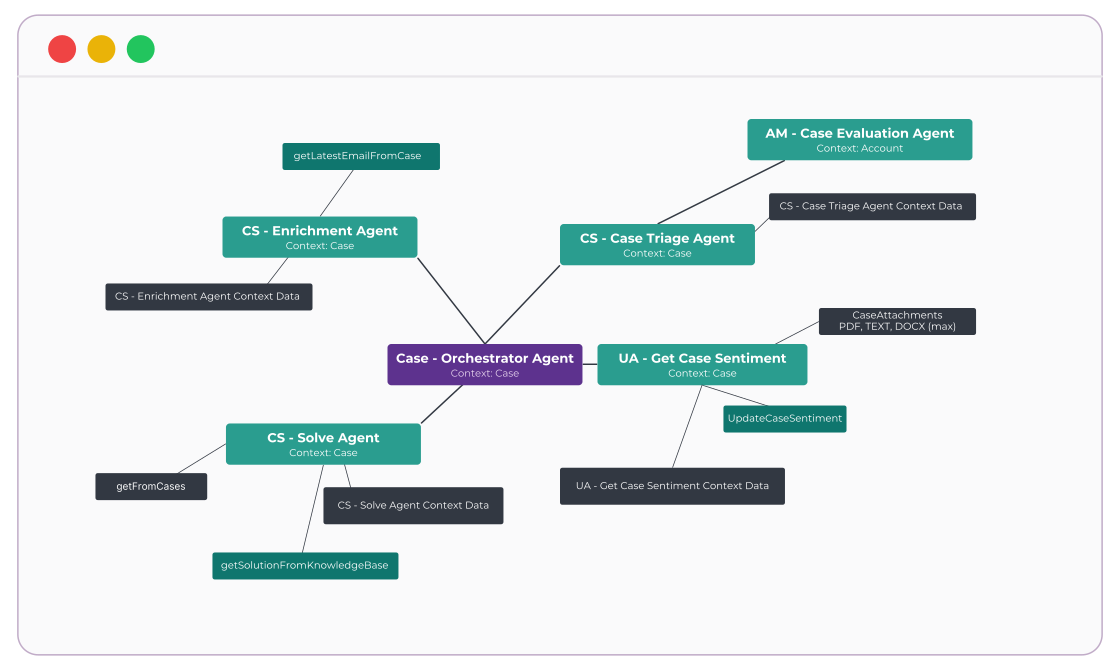
The automations are configured. Nothing coordinates the revenue process end to end.
Assignment rules and round-robin hand a lead to a rep, but they cannot see capacity, deal complexity, or whether the last lead was ever followed up. So reps take the easy leads, deals stay on whoever created them, and the ones that need chasing go quiet. A manager notices later and reassigns by hand, and routing that looked right last week is quietly wrong again. Ortoo Orchestrator coordinates those decisions, handoffs and exceptions as one coordinated revenue workflow.
Distribution that stops cherry-picking
The fastest reps take the easiest leads, while static assignment logic may overlook capacity, availability and expertise. Ortoo Orchestrator evaluates region, product, capacity, skills and named-owner rules together, creating a governed distribution decision rather than leaving work in a queue to be selected manually.
Ownership that moves with the deal
Opportunities can remain with the rep who created them even when stage, account ownership or deal requirements change. Ortoo Orchestrator governs ownership transitions as the opportunity progresses, while preserving named-account and configured ownership rules so pipeline responsibility remains clear.
Enrichment and qualification at intake
Incomplete and low-quality leads consume SDR time before meaningful engagement begins. Ortoo Orchestrator coordinates enrichment and qualification at intake, using deterministic checks and approved AI steps to determine whether a lead should progress, require review or be filtered before live assignment.
Follow-up that does not wait on memory
Follow-up often depends on a representative remembering the next action. Ortoo Orchestrator coordinates the configured follow-up step, monitors whether it occurs and escalates exceptions so the process does not depend on individual memory.
Automation executes tasks. Orchestration coordinates the revenue process.
Salesforce Flow executes configured automation. Assignment rules provide native matching. AI can interpret and enrich information. Ortoo Orchestrator coordinates those capabilities across the revenue process.
Salesforce provides powerful tools for automating individual tasks. Operational gaps appear when no workflow owns the transitions, handoffs and exceptions between them. Ortoo Orchestrator provides that coordination layer.
| Automation | Orchestration |
|---|---|
| Executes an individual task | Coordinates an end-to-end process |
| Assigns or updates a lead | Governs how the lead progresses between stages |
| Runs a rule, Flow or AI action | Coordinates rules, Flows, people and AI |
| Responds to one defined trigger | Maintains ownership of what should happen next |
| Records the result of one action | Provides visibility across the complete workflow |
Automation
Executes an individual task
Orchestration
Coordinates an end-to-end process
Automation
Assigns or updates a lead
Orchestration
Governs how the lead progresses between stages
Automation
Runs a rule, Flow or AI action
Orchestration
Coordinates rules, Flows, people and AI
Automation
Responds to one defined trigger
Orchestration
Maintains ownership of what should happen next
Automation
Records the result of one action
Orchestration
Provides visibility across the complete workflow
With Ortoo Orchestrator, existing Salesforce Flows, routing logic, deterministic automations and approved AI actions can operate as coordinated steps within the wider process. See how workflow automation and orchestration differ.
End-to-end revenue workflow orchestration
From intake and qualification through routing, ownership and follow-up, Ortoo Orchestrator coordinates the repetitive work and operational decisions that slow revenue teams down. Every action is logged in Salesforce, allowing reps to focus on selling rather than manually managing handoffs. Each action becomes a governed step in one revenue process rather than a separate tool or automation that teams must monitor.
Leads arrive from email, web forms and content-syndication sources as Salesforce records. The workflow validates required information, coordinates approved enrichment and uses AI selectively to interpret signals that would otherwise require manual research. Deterministic rules then decide whether the lead should progress, require review or be filtered before assignment.
Email-to-lead intakeWhat revenue workflow orchestration changes day to day
Routing reflects current conditions.
Leads reach an eligible representative using configured territory, capacity, availability and qualification criteria.
Speed to lead becomes measurable and governed.
Inbound leads enter a defined workflow immediately instead of waiting for manual triage.
No more cherry-picking.
Distribution follows governed eligibility and allocation rules rather than rep preference.
Follow-up becomes part of the workflow.
Configured next actions, timing and escalation rules reduce dependence on rep memory.
Opportunity ownership reflects the active process.
Ownership transitions follow configured account, stage and responsibility rules.
Cost stays predictable.
You pay for work completed, not the steps required to complete it.
Salesforce-native orchestration with a complete workflow audit trail
Ortoo Orchestrator runs natively inside Salesforce using the existing data, permissions and automation model. Salesforce remains the system of record. Every lead assignment, ownership transition and workflow action is logged against the relevant record. When the process requires an external system, enrichment provider, email service or AI model, it can be invoked as a governed step. Customers bring their approved provider and API key, and the actions remain visible in the audit trail.
Revenue workflow orchestration layer
Ortoo Orchestrator
Salesforce Sales Cloud
Leads, opportunities, accounts, territory rules, flows, queues
Connected capabilities
Enrichment providers, email tools, AI providers, analytics platforms
Define the outcome. Orchestrate the complete revenue workflow.
Define the intended outcome and configure the stages that must occur. Ortoo Orchestrator coordinates enrichment, qualification, routing, ownership and follow-up as one governed sequence. Revenue operations teams can adjust configured workflow logic as the go-to-market model changes, within the controls established by the Salesforce and platform teams.
Route this inbound lead to the right rep and log the assignment.
Use AI where judgement helps. Keep governed decisions deterministic.
AI is useful when the workflow needs to interpret unstructured information, classify intent, enrich context or draft content for review. Deterministic automation remains better suited to fixed business rules, routing constraints, territory logic, ownership and required approvals. Ortoo \n\n\nOrchestrator lets teams use AI only at the stages where it adds value while keeping governed operational decisions predictable. AI outputs can be constrained to controlled values, every action is logged against the Salesforce record, and customers can use an approved model and their own API key.
Classify this lead by buyer intent and segment.
Ortoo Orchestrator supports any LLM provider.
Revenue in action: Verivox
Verivox runs an online comparison portal covering energy, telco, insurance, and banking. Their loan-comparison division handles high inbound volume, previously distributed by consultants who self-selected cases, leading to cherry-picking and uneven performance across the team.
The challenge
- Consultants self-selecting cases, creating cherry-picking and uneven distribution
- No operational visibility over which consultant took which case and when
- Cases sitting in queues while consultants waited for the right one to appear
- A growing team increased distribution complexity as consultants grew from 3 to over 60
The impact
- 75% of inbound loan enquiries handled within 30 minutes
- 66% improvement in speed to response
- Conversion rates lifted across the loan-comparison workflow
- Full visibility and control over all case assignment processes
- Operations team adapts routing logic without technical assistance
“In the sales business you need to be able to act and adapt quickly. Being able to steer as a business user, without any requirement for IT, gives us independence and flexibility.”
Oliver Maier, Managing Director, Financial Comparison, Verivox
When revenue volume outgrows disconnected automation, revenue workflow orchestration produces measurable operational improvements.
Entrust
Lead and opportunity ownership continuity, with stage-triggered reassignment keeping deals on the right reps.
Read the case studyVerivox
Workflow-driven distribution replacing consultant self-selection, scaled from 3 to 60+ consultants.
Read the case studyLAPU
University admissions routing at scale. Assignment automated; advisors focused on the conversations that convert.
Read the case studyRelated pages
Salesforce Lead Management
Govern the complete lead lifecycle from capture and qualification through routing, engagement, conversion and recycling.
Read moreLead assignment in Salesforce
Multi-factor lead routing, deep-dive.
Read moreSalesforce lead distribution
Fair, capacity-aware lead distribution.
Read moreUsing AI to triage leads automatically
AI lead triage at intake.
Read moreMastering opportunity assignment in Salesforce
Stage-triggered opportunity reassignment.
Read moreSalesforce territory management for sales
Multi-factor territory routing.
Read moreSalesforce Service Workflow Orchestration
Companion solution for case, escalation, and resolution workflows.
Read moreSalesforce Lead Routing
How Salesforce leads are evaluated, assigned and re-routed using territory, capacity, qualification and SLA.
Read moreQ-Assign
Assignment engine behind the routing step.
Read moreRevenue workflow orchestration: common questions
What is revenue workflow orchestration in Salesforce?
Revenue workflow orchestration is the coordination of the people, Salesforce records, Flows, assignment logic, AI actions and external tools involved in an end-to-end revenue process. Sales workflow automation executes individual tasks. Orchestration determines how those tasks connect, what should happen next, who owns each stage and how exceptions are handled.
What is the difference between revenue workflow orchestration and lead routing?
Lead routing determines which representative or team should receive a lead based on criteria such as territory, capacity, qualification and SLA. Revenue workflow orchestration governs the broader process around routing, including intake, enrichment, qualification, ownership transitions, follow-up, escalation and opportunity progression. Routing is one capability inside the complete revenue workflow.
How does this work with existing territory rules and round-robin?
Existing Salesforce territory structures, assignment rules, queues and round-robin processes can remain in place. Ortoo Orchestrator coordinates across them and can add advanced routing through Q-assign where the existing logic does not account for factors such as capacity, availability, skills or operational exceptions.
Can this stop reps cherry-picking leads?
Yes. When eligible work is assigned automatically rather than left in a shared queue for self-selection, distribution follows the configured business rules. Q-assign can account for factors such as eligibility, capacity, availability and allocation method, helping reduce selective picking and uneven workload distribution.
What is the difference between Salesforce Flow and workflow orchestration?
Salesforce Flow is a powerful tool for automating defined actions and record-based processes. Workflow orchestration coordinates multiple automations, users, decisions and systems across a longer-running business process. Ortoo Orchestrator works with existing Flows and makes them coordinated stages within a governed revenue workflow rather than requiring organisations to discard what they have already built.
What AI is included, and how is it governed?
Ortoo Orchestrator supports AI-enabled workflow steps for activities such as classification, enrichment and interpretation. AI is optional per step rather than required for every action. Fixed routing, territory, ownership and approval decisions can remain deterministic. Customers can use an approved LLM provider with their own API key, and workflow actions are logged against the relevant Salesforce record.
How long does it take to get one revenue workflow running?
Implementation depends on the workflow, Salesforce configuration and number of connected systems. The recommended approach is to begin with one clearly defined revenue workflow, retain the existing Salesforce setup and expand after the first process has been validated. Confirm the expected implementation scope with the Ortoo team for the specific use case.
What is the difference between process automation and process orchestration?
Process automation completes predefined tasks automatically. Process orchestration coordinates multiple automated and human tasks as one end-to-end process. It governs sequence, ownership, dependencies, handoffs, timing and exceptions so that separate automations contribute to one measurable business outcome.
Is Ortoo Orchestrator an agentic process automation platform?
Ortoo Orchestrator supports agentic and deterministic workflow steps within the same process. AI can interpret context or perform approved reasoning where useful, while predictable actions can run without an LLM. This allows the revenue workflow to use agentic automation selectively without making every operational decision probabilistic.
See where your revenue workflow stalls
Bring one lead or opportunity workflow. We will map the current process and identify where connected orchestration can reduce manual triage, ownership drift, cherry-picking and follow-up delays.
Installs natively into Salesforce. Start with one workflow, expand to others as the team is ready. You pay for work completed, not the steps required to complete it.