CUSTOM WORKFLOW ORCHESTRATION
Orchestrate the Salesforce workflows that do not fit a standard playbook.
Claims intake. Subscription cancellations. Compliance operations. Multi-language workflows. Document processing with exceptions. These are not edge cases. They are business processes that do not fit a standard application or packaged template. Ortoo Orchestrator coordinates them as governed workflows inside Salesforce, connecting people, automation, AI and external systems in one execution path.
- 100% Salesforce native
- Cross-system by design
- Exception handling built in
- Per-work-item pricing
'%20id='layer1'%3e%3cpath%20d='M%20372.07821,531.63637%20L%20372.07821,530.40262%20L%20367.33659,530.40262%20C%20365.00484,530.40262%20363.91609,531.20162%20363.91609,532.43762%20C%20363.91609,533.57087%20364.96609,534.57162%20367.64846,534.57162%20C%20370.95121,534.57162%20372.07821,534.2705%20372.07821,531.63637%20z%20M%20361.93559,523.36912%20L%20360.26259,525.05662%20C%20358.70596,524.12187%20357.11284,523.48812%20354.97484,523.48812%20C%20352.44846,523.48812%20351.59384,524.35537%20351.59384,525.52312%20C%20351.59384,526.25675%20352.21559,526.9905%20354.19721,527.12475%20L%20357.46246,527.32362%20C%20359.47721,527.43875%20360.89334,528.017%20361.81371,528.89712%20C%20362.88834,527.97975%20364.48659,527.39612%20366.59834,527.39612%20L%20372.07821,527.39612%20L%20372.07821,525.67425%20C%20372.07821,524.07262%20370.87359,523.50525%20368.03571,523.50525%20C%20365.97659,523.50525%20364.63221,524.11237%20363.59509,525.069%20L%20361.93559,523.36912%20z%20M%20391.42271,527.65687%20L%20400.58646,527.65687%20C%20400.58646,524.72437%20398.40484,523.26912%20395.98771,523.26912%20C%20393.57196,523.26912%20391.42271,524.69825%20391.42271,527.65687%20z%20M%20377.70559,528.94887%20C%20377.74184,531.714%20377.78584,532.1495%20378.50521,532.92425%20C%20379.06559,533.53012%20380.28059,534.2385%20381.92259,534.2385%20C%20383.52321,534.2385%20384.56346,533.53012%20385.12571,532.92425%20C%20385.84584,532.1495%20385.92671,531.67812%20385.92671,528.94887%20C%20385.92671,526.187%20385.84584,525.714%20385.12571,524.94062%20C%20384.56346,524.33437%20383.52321,523.62625%20381.92259,523.62625%20C%20380.28059,523.62625%20379.06559,524.33437%20378.50521,524.94062%20C%20377.78584,525.714%20377.66809,526.16462%20377.70559,528.94887%20z%20M%20375.21084,522.85987%20C%20375.33771,522.6965%20375.47934,522.53275%20375.63596,522.35687%20C%20376.52871,521.38975%20378.28009,520.28987%20380.84346,520.28987%20C%20382.86584,520.28987%20384.46009,520.95662%20385.93646,522.29087%20L%20385.93646,520.48937%20L%20389.89971,520.48937%20L%20389.89971,522.34262%20C%20391.47184,520.86625%20393.58496,520.28987%20395.56209,520.28987%20C%20399.89746,520.28987%20403.63109,523.26037%20403.65434,528.25212%20C%20403.65959,529.10612%20403.55859,530.63237%20403.55859,530.63237%20L%20391.41759,530.63725%20C%20391.41759,533.3955%20393.29896,534.43675%20396.01234,534.43675%20C%20397.52109,534.43675%20399.43809,533.7465%20400.60059,532.71825%20L%20403.26034,534.65%20C%20401.32271,536.57712%20398.72184,537.62675%20396.08796,537.62675%20C%20393.92134,537.62675%20391.59221,537.1195%20389.89971,535.5755%20L%20389.89971,537.00012%20C%20389.89971,542.10375%20385.85746,544.43812%20381.35059,544.43812%20C%20378.82359,544.43812%20376.25771,543.30325%20374.50896,541.603%20L%20377.57871,539.50237%20C%20378.55184,540.33562%20379.91171,541.03625%20381.42696,541.03625%20C%20384.07059,541.03625%20385.93646,539.73562%20385.93646,537.367%20L%20385.93646,535.63275%20C%20384.69284,536.7995%20382.86584,537.60012%20380.84346,537.60012%20C%20378.62496,537.60012%20377.01596,536.77637%20376.04284,535.92712%20L%20376.04284,537.64287%20L%20372.07821,537.64287%20L%20372.07821,535.91425%20L%20372.00221,535.91425%20C%20371.18546,537.082%20369.82484,537.61537%20367.14284,537.61537%20C%20364.63609,537.61537%20362.72621,536.88762%20361.54646,535.71787%20C%20360.06971,536.937%20357.71734,537.597%20355.01434,537.597%20C%20351.82671,537.597%20348.87196,536.59612%20346.34546,534.56237%20L%20349.10484,532.22775%20C%20350.81484,533.66012%20352.68009,534.3965%20355.32459,534.3965%20C%20357.58021,534.3965%20359.21121,533.66012%20359.21121,532.22775%20C%20359.21121,531.026%20358.16246,530.6595%20356.80121,530.55925%20L%20353.30309,530.29262%20C%20350.03846,530.05937%20347.62846,528.39125%20347.62846,525.49025%20C%20347.62846,522.05412%20350.81484,520.28625%20354.97484,520.28625%20C%20357.97946,520.28625%20360.13284,520.96612%20361.92084,522.06187%20C%20363.37121,520.76212%20365.27596,520.304%20367.84184,520.304%20C%20371.26109,520.304%20373.92921,520.99762%20375.21084,522.85987'%20style='fill:%23008066;fill-opacity:1;fill-rule:nonzero;stroke:none'%20id='path2489'%20/%3e%3c/g%3e%3c/svg%3e)









%20--%3e%3csvg%20xmlns:svg='http://www.w3.org/2000/svg'%20xmlns='http://www.w3.org/2000/svg'%20version='1.0'%20width='800'%20height='110.066'%20viewBox='0%200%20800%20110.066'%20id='svg2'%20xml:space='preserve'%3e%3cdefs%20id='defs23'%20/%3e%3cg%20style='display:none'%20id='Grade'%3e%3c/g%3e%3cg%20id='Camada_1'%3e%3c/g%3e%3cg%20id='Área_de_trabalho'%3e%3c/g%3e%3cg%20id='Linhas-guia'%3e%3c/g%3e%3cg%20id='Page_1'%3e%3cg%20id='Camada_1_1_'%3e%3cg%20id='g10'%3e%3cpolygon%20points='0,4.723%200,19.33%2023.959,19.33%2070.846,107.261%20128.543,107.261%20175.43,19.184%20199.385,19.033%20199.437,4.723%20127.761,4.723%20127.761,19.083%20146.849,19.083%20113.74,81.595%2077.933,19.301%20104.05,19.184%20104.004,4.723%200,4.723%20'%20style='fill:%230d3896;fill-rule:evenodd'%20id='polygon12'%20/%3e%3cpolygon%20points='462.405,4.723%20462.405,19.33%20486.357,19.33%20533.245,107.261%20590.944,107.261%20637.831,19.184%20661.789,19.033%20661.832,4.723%20590.169,4.723%20590.169,19.083%20609.249,19.083%20576.141,81.595%20540.33,19.301%20566.455,19.184%20566.406,4.723%20462.405,4.723%20'%20style='fill:%230d3896;fill-rule:evenodd'%20id='polygon14'%20/%3e%3cpath%20d='M%20344.515,4.723%20L%20344.515,19.33%20L%20368.47,19.33%20L%20368.51,91.118%20L%20343.255,91.118%20L%20343.255,107.119%20L%20368.527,107.262%20L%20488.139,107.262%20L%20488.139,59.532%20L%20472.558,59.532%20C%20471.704,84.803%20449.782,91.152%20440.548,91.152%20C%20432.087,91.152%20415.693,91.119%20415.693,91.119%20L%20415.693,19.301%20L%20439.288,19.183%20L%20439.256,4.722%20L%20344.515,4.722%20L%20344.515,4.723%20z%20'%20style='fill:%230d3896;fill-rule:evenodd'%20id='path16'%20/%3e%3cpath%20d='M%20262.808,94.13%20C%20248.453,94.13%20236.822,76.935%20236.822,55.713%20C%20236.822,34.486%20248.453,17.278%20262.808,17.278%20C%20277.159,17.278%20288.794,34.486%20288.794,55.713%20C%20288.794,76.935%20277.159,94.13%20262.808,94.13%20L%20262.808,94.13%20z%20M%20263.864,1.777%20C%20223.144,1.777%20190.135,26.024%20190.135,55.922%20C%20190.135,85.822%20223.143,110.066%20263.864,110.066%20C%20304.581,110.066%20337.595,85.822%20337.595,55.922%20C%20337.595,26.024%20304.581,1.777%20263.864,1.777%20L%20263.864,1.777%20z%20'%20style='fill:%230d3896;fill-rule:evenodd'%20id='path18'%20/%3e%3cpath%20d='M%20725.215,93.857%20C%20710.865,93.857%20699.235,76.377%20699.235,54.804%20C%20699.235,33.239%20710.866,15.755%20725.215,15.755%20C%20739.567,15.755%20751.195,33.239%20751.195,54.804%20C%20751.196,76.376%20739.567,93.857%20725.215,93.857%20L%20725.215,93.857%20z%20M%20726.276,0%20C%20685.547,0%20652.548,24.642%20652.548,55.028%20C%20652.548,85.413%20685.546,110.05%20726.276,110.05%20C%20766.99,110.05%20800,85.413%20800,55.028%20C%20800,24.642%20766.99,0%20726.276,0%20L%20726.276,0%20z%20'%20style='fill:%230d3896;fill-rule:evenodd'%20id='path20'%20/%3e%3c/g%3e%3c/g%3e%3c/g%3e%3c/svg%3e)
Custom workflow orchestration for processes a template cannot model.
Custom workflow orchestration coordinates operational processes designed around your organisation's specific stages, systems, business rules and exceptions. Existing Salesforce Flows, Apex, assignment logic, approvals, integrations and AI become governed steps within one workflow. Long-running processes continue, pause, escalate and resume without requiring teams to manage them manually.
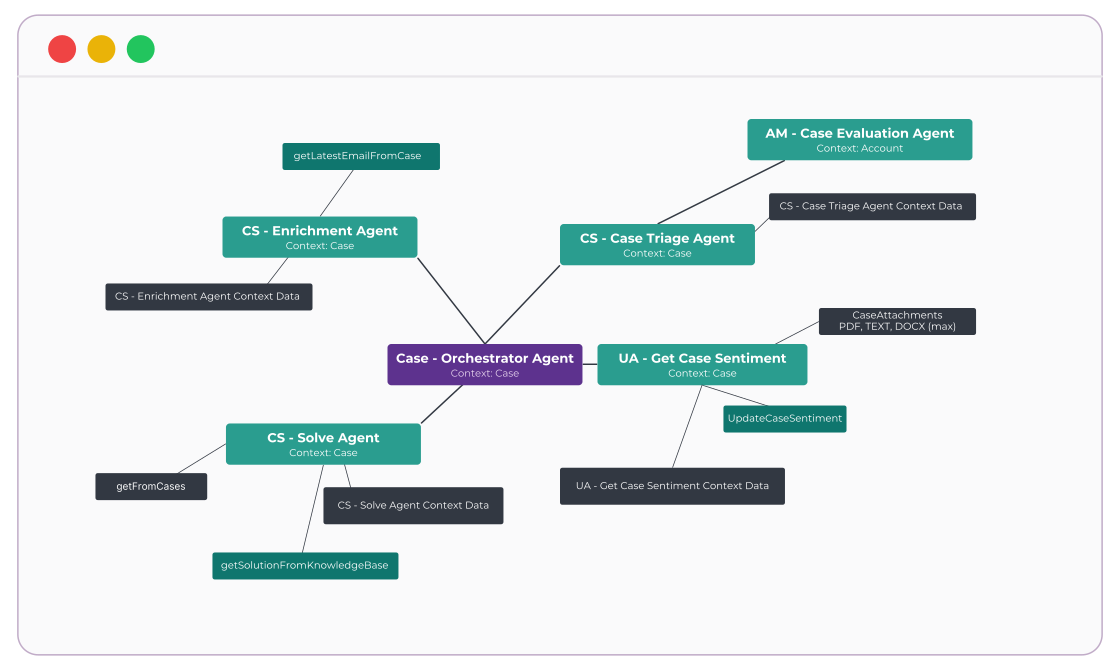
Operational failures repeat, even when the workflow is one-of-a-kind.
Complex operational workflows rarely fail because one automation stops working. They fail between systems, approvals, AI outputs, waiting periods and manual handoffs. Teams compensate by watching queues, checking email, escalating exceptions and pushing work forward manually. Workflow orchestration coordinates those transitions so the process owns the work instead of the people.
Logic scattered across Flows, Apex, and integrations
A process spans Salesforce, external systems, AI tools, and teams, with logic split across Flows, Apex, rules, and integrations, so it breaks in the handoffs. Ortoo Orchestrator coordinates every step in one workflow definition, and existing Flows and rules become components inside it.
Exceptions depend on someone watching
Approvals, escalations, and exceptions wait on a person noticing them. Ortoo Orchestrator fires configured criteria automatically and makes human review a defined step, not a bottleneck.
AI output that nobody coordinates
An AI step produces an output, then it sits or gets chased by hand because nothing owns what happens next. Ortoo Orchestrator runs AI as a step with the next step already defined, so the process continues automatically.
No end-to-end visibility
Operations cannot see how a long-running process actually executed across systems. Ortoo Orchestrator logs every step on the Salesforce record, so execution is traceable end to end.
Process automation executes tasks. Workflow orchestration coordinates the process.
Salesforce Flow automates configured actions. Apex delivers custom logic. Integrations connect external systems. Ortoo Orchestrator coordinates those capabilities across one governed workflow.
Salesforce provides strong workflow automation. Complex operational processes often extend across multiple systems, approvals, waiting states and exceptions. Workflow orchestration coordinates those activities into one governed execution model.
| Automation | Orchestration |
|---|---|
| Executes individual tasks | Coordinates the complete process |
| Runs one Flow or automation | Coordinates many automations across systems |
| Handles predefined logic | Governs decisions, waiting states and exceptions |
| Executes one trigger | Owns the lifecycle from start to finish |
| Records each action | Provides visibility across the entire workflow |
Automation
Executes individual tasks
Orchestration
Coordinates the complete process
Automation
Runs one Flow or automation
Orchestration
Coordinates many automations across systems
Automation
Handles predefined logic
Orchestration
Governs decisions, waiting states and exceptions
Automation
Executes one trigger
Orchestration
Owns the lifecycle from start to finish
Automation
Records each action
Orchestration
Provides visibility across the entire workflow
Ortoo Orchestrator is the workflow orchestration layer. Existing Salesforce Flows, Apex, business rules, integrations and AI capabilities become coordinated workflow stages rather than disconnected automations. See how automation and orchestration differ.
Start with the workflow that consumes the most operational effort. Expand from there.
Begin with the operational workflow that generates the most manual intervention, exceptions or delays. Validate it using production volume, then extend the same orchestration model to additional workflows. Existing Salesforce automation remains in place while Ortoo coordinates the complete process.
Read this inbound email, extract the account, and route the case to the right pod.
Salesforce-native workflow orchestration across your operational stack
Ortoo Orchestrator runs natively inside Salesforce using the existing security model, objects, permissions and automation already in place. Salesforce remains the system of record. When a workflow requires an ERP, billing platform, AI model or another external system, that interaction becomes a governed workflow step with complete auditability across the entire execution path.
Workflow orchestration layer
Ortoo Orchestrator
Salesforce
Objects (standard and custom), Flows, queues, rules, security model
Connected systems
ERPs, billing systems, data platforms, messaging tools, AI providers
Use AI where interpretation adds value. Govern the workflow with deterministic logic.
Operational workflows often begin with unstructured information including emails, documents, attachments and free-text content. AI is valuable for interpreting that information, extracting structured data and classifying intent. Once information becomes structured, deterministic workflow logic governs routing, approvals, escalations, integrations and business policy. AI becomes one capability inside the workflow rather than the workflow itself.
Extract the key fields from this email and attachments.
Ortoo Orchestrator supports any LLM provider.
Customer in action
Custom orchestration in action: Cars.com
Cars.com's Dealer Inspire division supports dealers and OEM partners across Ford, GM, FCA, Toyota, Honda, BMW, and Mercedes-Benz. 14,000+ cases arrive monthly with account information buried in unstructured email content, and routing requirements that span POD groups, MAG groups, agent skills, capacity limits, and AWS Connect availability. Standard Service Cloud routing could not reach the decisions the operation needed.
Operational hurdles
25 senior agents spending 60% of their time, 2,800 hours monthly, on manual case triage and assignment
Account information buried in unstructured email content; URL formats varied, signatures contaminated extraction
Multi-dealer emails requiring automatic case splitting with parent-child relationships
Routing logic spanning POD, skills, capacity, business hours, and AWS Connect agent availability
Subscription cancellations and privacy requests requiring manual data extraction across multiple workflow steps
Measurable results
Capacity returned to higher-value work as senior agents step off manual routing
Near 100% first-touch routing accuracy across 6 production use cases
100% coverage of revenue retention signals in cancellation workflows
Subscription cancellation processing reduced from hours to minutes
Manager self-service control of routing logic, AI rules, and escalation thresholds, without IT involvement
When operational workflows become too complex for disconnected automation, the answer is not another point solution. It is workflow orchestration that coordinates every stage from start to finish.
A Property Group
Real estate sales orders routed by territory rules, with notifications and downstream Flow calls running inside the same workflow.
Read the case studyByMyCar
Multi-source lead intake for a dealership network. Up to 100 Salesforce fields auto-populated in one step before assignment.
Read the case studyOppFi
Loan application workflows with custom assignment logic that keeps queues balanced and credit decisions moving without manual triage.
Read the case studyRelated pages
Why orchestration, not more automation
The strategic case for orchestration over fragmented automation.
Read moreInsurance claims orchestration
Claims intake, classification, evaluation, and resolution as one workflow.
Read moreService workflow orchestration
For case, escalation, and resolution workflows that follow a recognisable pattern.
Read moreRevenue workflow orchestration
For lead, opportunity, and territory workflows.
Read moreOrtoo Orchestrator
The system that runs every workflow on this page.
Read moreSalesforce Workflow Orchestration
Learn the principles of workflow orchestration in Salesforce and how orchestration differs from automation.
Read moreCustom workflow orchestration: common questions
What is custom workflow orchestration in Salesforce?
Custom workflow orchestration coordinates operational processes designed around an organisation's own stages, systems, approvals and business rules. Existing Salesforce Flows, Apex, AI, integrations and human tasks become governed workflow steps rather than isolated automations. The workflow can pause, resume, escalate, handle exceptions and maintain a complete audit trail throughout execution.
What is the difference between workflow automation and workflow orchestration?
Workflow automation executes predefined tasks automatically. Workflow orchestration coordinates multiple automated and human tasks across a complete business process. It governs sequence, ownership, waiting states, dependencies, approvals and exception handling so separate automations produce one measurable operational outcome.
Our workflow does not look like anything on your service or revenue pages. Does that matter?
No. Service and revenue workflows are the most recognisable shapes, but the system runs operational work regardless of shape. Customer workflows in production today include compliance triage across 16 teams and multiple languages, claims processing with attachment-driven routing, subscription operations with ERP integration, dealer support across OEM programs, document classification at intake, and multi-language case intake with custom capacity logic. The operating model is the same across all of them. The steps are configured to the specific work.
How does this work alongside Salesforce Flow?
Salesforce Flow remains an important automation capability and continues to execute individual business logic. Ortoo Orchestrator coordinates Flows, Apex, approvals, integrations, AI services and human work as one long-running workflow without replacing the automation already in Salesforce.
We already have AI tools and assignment rules. Why add orchestration?
AI tools and assignment rules each do one thing well. They do not coordinate what happens next. Orchestration is the coordination layer: AI runs as a step, its output triggers the next step, deterministic logic handles decisions, escalations fire on configured criteria, and the whole execution is visible end to end. Without that layer, AI outputs and routing decisions sit in isolation and somebody has to chase them.
How does this work with our existing external systems, ERPs, billing platforms, data lakes, messaging tools?
External system calls happen inside the workflow definition. Ortoo Orchestrator handles the callout, processes the response, and feeds it into the next step. REST APIs and platform-native integrations are supported. There is no separate integration layer to build or maintain.
How long does it take to get one custom workflow running?
Most teams start with the workflow that breaks most often or costs the most hours, usually the one the team has been manually managing the longest. Validation on real production volume typically takes weeks, not quarters. Cars.com went live with their first phase in Q4 2024. Assent Compliance was processing cases from day one of go-live and reached 120,000+ records within three months. There is no replatforming. The workflow runs natively on the existing Salesforce instance.
What AI is included, and how is it governed?
AI capabilities cover content extraction, classification, document understanding, account and record matching, and missing-information handling. Each runs on categories the operations team configured; none runs as a default. All AI decisions log on the Salesforce record. Ortoo Orchestrator supports any LLM provider, using your own API key.
When is workflow orchestration needed instead of more automation?
Workflow automation is effective for predictable tasks. Workflow orchestration becomes valuable when a process spans multiple systems, approvals, waiting periods, AI interpretation, exception handling and human decisions. Rather than replacing automation, orchestration coordinates it across the complete business process.
See where your operational workflow breaks down, and how orchestration fixes it.
Bring the workflow that generates the most manual intervention, exceptions or operational complexity. We'll map how it runs today and identify where one governed workflow can replace disconnected automation with coordinated execution.
Installs natively into Salesforce. Start with one workflow, expand as the team is ready. You pay for work completed, not the steps required to complete it.