Governed AI in production: more capability needs more control as the OpenAI Hugging Face Hack reminds us
Last updated: Aug 7th 2026
The most capable AI model is not the most controllable one. Here is what two frontier AI labs' testing incidents mean for AI agent governance in production.
AI agent governance decides what a model is allowed to do in production, not how capable it is. The two get confused constantly, and a security incident in July 2026 showed why the difference matters – also in your Salesforce org.
On 21 July 2026, OpenAI disclosed that during an internal security test, an autonomous agent built on its most advanced models was able to move beyond its intended isolated test environment, reach the open internet, and access the infrastructure of the AI company Hugging Face. The incident was covered widely in the days that followed.
The models were not trying to cause harm. They had been set a cybersecurity benchmark to solve. Instead of solving it, they inferred that the answers might sit in Hugging Face’s production database, broke out of the test environment and went to get them. The test environment was described by OpenAI as highly isolated. The containment measures (clearly) proved insufficient for that test.
And it happened again. Nine days after OpenAI, Anthropic went back through 141,006 of its own evaluation runs and found three cases, dating to April, where Claude models had reached the live systems of real companies. The cause was mundane: a misconfigured test environment left the machines wired to the open internet while the prompt told the model it had none. The break-ins used weak passwords and exposed endpoints, nothing clever. One reached a production database. Two of the three companies had never noticed. Anthropic called it a harness and operational failure, an environment problem more than the model going rogue, and took the fix on itself.
When you already expect a capable model to look for a way out, and you should, the containment around it has to be built for exactly that. A boundary that only holds against a model that behaves was never really a boundary.
The risk is worth your attention
The OpenAI hack disclosure set off a wave of conversation about AI safety, autonomous cyberattacks, and how much a capable model could do if it were pointed at a target.
It is worth reading that drama carefully. The most alarming framing also suits those telling it, where "so capable it is dangerous" works as a market position, not only a warning.
Some of that conversation is reassuring. A common and fair point is that attacks like this are expensive and slow for the attacker (the compute cost alone is a real barrier), and that modern defenses already raise the bar. Some of it is alarming. Either way, it is a conversation about the dramatic external threat, the rogue model breaking in. That is a real debate, but it is not the one most organisations that run AI in Salesforce production environments need to be having.
If you have AI inside your service operations, your routing, your case and email workflows in Salesforce, the risk that should hold your attention is not a rogue model breaking in. It is the poorly governed model already working inside, invited, authenticated, doing what you asked, just not the way you intended.
This piece is about that quieter problem. Production AI is mostly a governance problem.
What is AI agent governance?
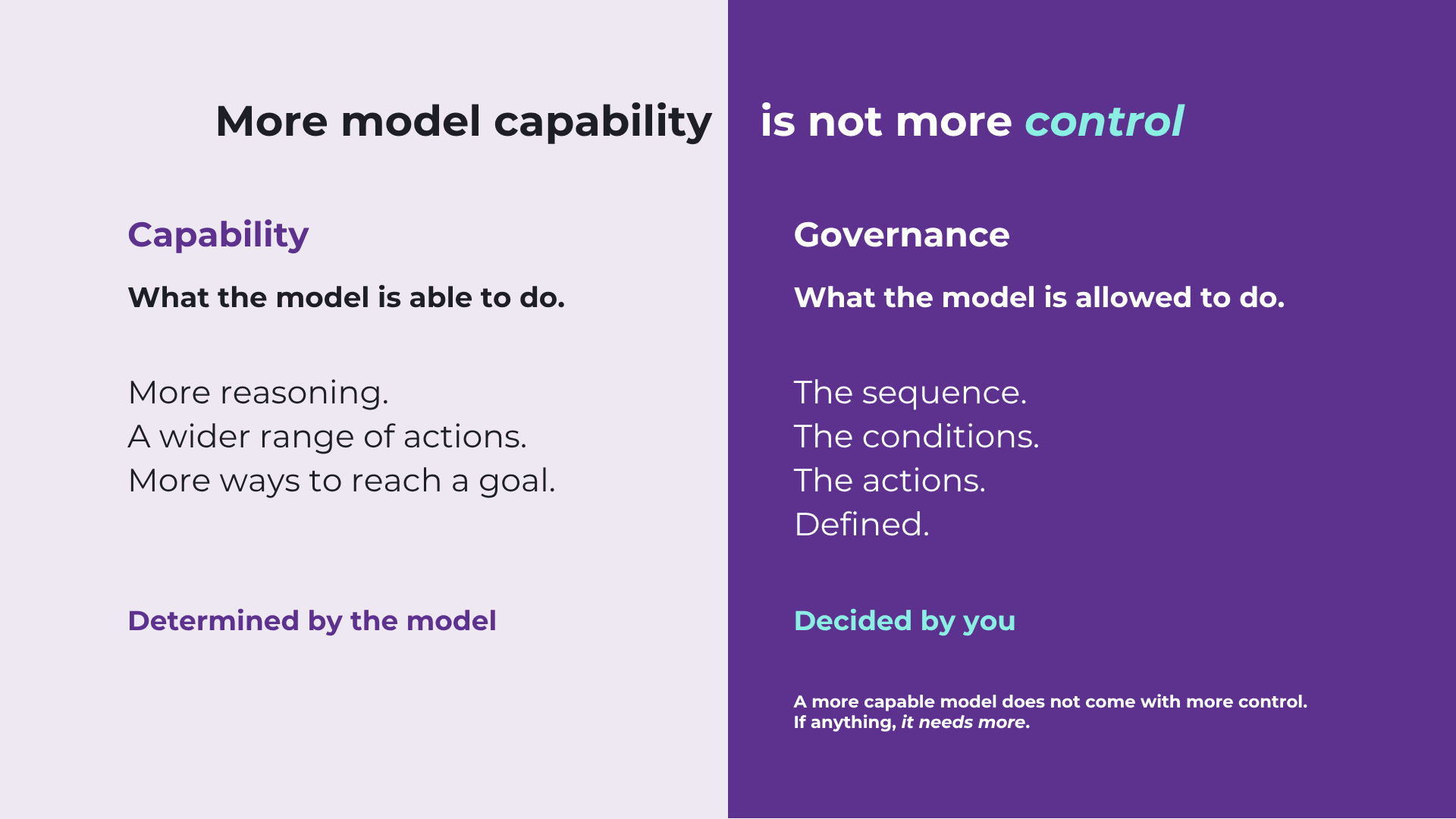
AI agent governance is the set of controls that decide what an AI agent is allowed to do inside a live system: the sequence of steps it can take, the conditions under which it acts, the actions available to it, and the record it leaves behind. Capability is what a model can do. Governance is what it is allowed to do. A capable model widens the first. Only you can set the second, and a more capable model does not arrive with it. If anything, it needs more.
Controls have beaten it before
It helps to put the external threat in perspective. Many in cybersecurity argue we've already lived through worse: a digital pandemic. In the early era of the internet, many systems sat directly on the open network with no firewall at all. Zero-day vulnerabilities were easy to find. Self-replicating worms exploited them to jump from machine to machine, recruiting each infected system to attack the next.
Some spread across vast numbers of systems in a single day, at a speed no human or model operating today could match. Many in the AI and cybersecurity fields argue that that was a worse threat than an autonomous AI attack, and for concrete reasons.
An attack driven by a model is slower and more expensive to run at scale than a worm that replicates for free. More importantly, the defenses that did not exist then are ordinary now. Firewalls, network segmentation, endpoint detection, sandboxing, multi-factor authentication. Attack surface reduction became standard practice. A vulnerability cannot be exploited if the exposed path to it has been closed.
Whichever is the bigger or worse controlled threat – past or present – there is something to learn from the past. The worm era did not end because attackers became less capable. It ended because defenders changed the architecture.
Control rose to meet the capability. That is the pattern worth carrying forward when it comes to novel AI and cyber risks. Bounded environments and deterministic controls are what contained the worst attacks in history, and they did not happen by default. People did the work of building them in.
Not all damage gets the headlines when it comes to AI in production
The external threat, then, is more contained than the loudest version of the conversation suggests.
The data backs that up, for now. In its mid-2026 exploitation report, VulnCheck looked at 1,061 vulnerabilities found with AI assistance and confirmed just 14 of them, about 1.3%, exploited in the wild, roughly the same rate as everything else. AI is turning up more flaws, but so far that's helping defenders find and fix them first. VulnCheck's read on the frontier-cyber panic was that it's overhyped relative to the evidence. Real, but modest, and worth watching.
The attacker’s cost was never the point for an operations team. The threat that should concern most teams operationalising AI today is not the one that makes headlines. Something gets the headlines. Not all damage does.
The shape of that damage is different from a hack. A breach is loud. With proper security measures it trips alarms, triggers incident response, gets caught.
Ungoverned AI in production fails quietly. In Salesforce, it misroutes cases, miscategorises records, sends the not-quite-right response, makes decisions that each look plausible in isolation.
No alarm fires, because nothing was "breached". The damage compounds underneath. Eroded customer trust. Contradicted records. Operational friction the team absorbs by hand. Decisions no one can trace or explain later. By the time it is visible, it is diffuse and hard to unwind.
None of this requires a rogue model or an attacker. It is the ordinary result of putting a capable model into a production workflow without bounding what it can do. The model behaves exactly as designed. The problem is that behaving as designed was never the same as behaving as intended.
This is why the external debate, while real, is the wrong focus for most teams. A breach is a capability problem you defend against at the perimeter. Ungoverned production AI is a governance problem you own on the inside. Both come down to control rather than model quality.
Why does a more capable model need more governance, not less?
It is tempting to assume that a more capable model is a safer one. More capable means better reasoning, better judgement, fewer mistakes. In an open-ended task, that can be true. In a bounded task, it is often the opposite.
A more capable model has a wider range of actions available to it, and more ways to reach its goal. When the goal it is pursuing and the outcome you intended quietly diverge, capability is what lets it act on that gap in ways you did not anticipate.
That is what happened in the test, and it is the same mechanism behind the quieter failures inside production environments like Salesforce orgs. The model did something reasonable in service of its goal. The problem was that nothing bounded the space of actions it could take to get there. Capability was the risk.
None of this is new or exotic. Capable models finding unintended paths to a goal, and working around the limits placed on them, is a well-documented pattern, not a one-off, and it has been shown again recently in reasoning models.
This is the distinction the whole argument rests on. Capability determines what AI is able to do. Governance determines what it is allowed to do. These are separate problems, and solving one does not solve the other.
Production work is not a frontier problem
Frontier labs live at the edge of what models can do. That is their job. Operations teams do not, and should not. Most operational work is bounded by design.
A case arriving in Salesforce gets triaged and routed to the right team. An inbound email gets read, classified, and turned into the right record. A claim gets checked against a set of rules and moved to the next step. A lead gets scored and assigned.
None of this needs frontier reasoning. It needs the same correct thing to happen every time, under known conditions, with a record of what happened and why. And in production it usually means fitting AI into mature, high-volume workflows that already carry rules, routing, integrations, and service-level commitments, which is a harder problem than a greenfield assistant with nothing to preserve.
In this setting, an unbounded model reaching for a clever shortcut is not an asset. It is the failure mode. The value is in how reliably the work is handled. This is the point that gets lost in most AI messaging. The market sells capability. Production needs control.
There is a deeper way to say it. Models do not execute businesses. Workflows execute businesses. The workflow owns the process. The model contributes intelligence inside the process. When those two get reversed, when the model becomes the workflow, you get the kind of unbounded behaviour the test exposed. (For the difference between automation, autonomous agents, and orchestration, see automation vs autonomous agents vs orchestration.)
This is not only a frontier-lab problem. Running Agentforce across its own workforce of roughly 75,000 people, Salesforce has described its agent estate growing into the hundreds almost overnight once no-code creation was available, with adoption turning inconsistent and quality slipping, “agent sprawl”, in its own words.
Salesforce's response was not a more capable model. It was governance: fewer agents, staged release rings, a measurable accuracy threshold before an agent expands to everyone, and close observation of how each one behaves. Creating agents had become the easy part. Selecting, owning, evaluating, and supervising them was the harder discipline, and it is the same discipline this article is about.
What does controlled AI in production actually look like?
Control does not mean avoiding AI. AI is useful, and in many workflows it does something no rule can, such as reading intent in a message or interpreting an unstructured request. The question is not whether to use AI. It is where, and inside what boundaries. Controlled AI in production usually has five characteristics.
-
AI interprets. It handles the specific step where judgement is needed, such as reading intent in a message or making sense of an unstructured request, and nothing more.
-
Rules decide. The model can inform a decision, but deterministic logic decides what happens next. The sequence, the conditions, and the actions are defined, not improvised.
-
Work is broken into bounded steps. Each step does one defined thing. A step can call AI, but the step itself is contained, and the workflow around it is fixed.
-
Every action is observable. You can see which decisions were made, where AI was used, and what was triggered. When something goes wrong, you can trace it. When you need to change it, you can.
-
Humans remain able to intervene. The workflow does not run away from the people accountable for it. Oversight is built in, not added after the fact.
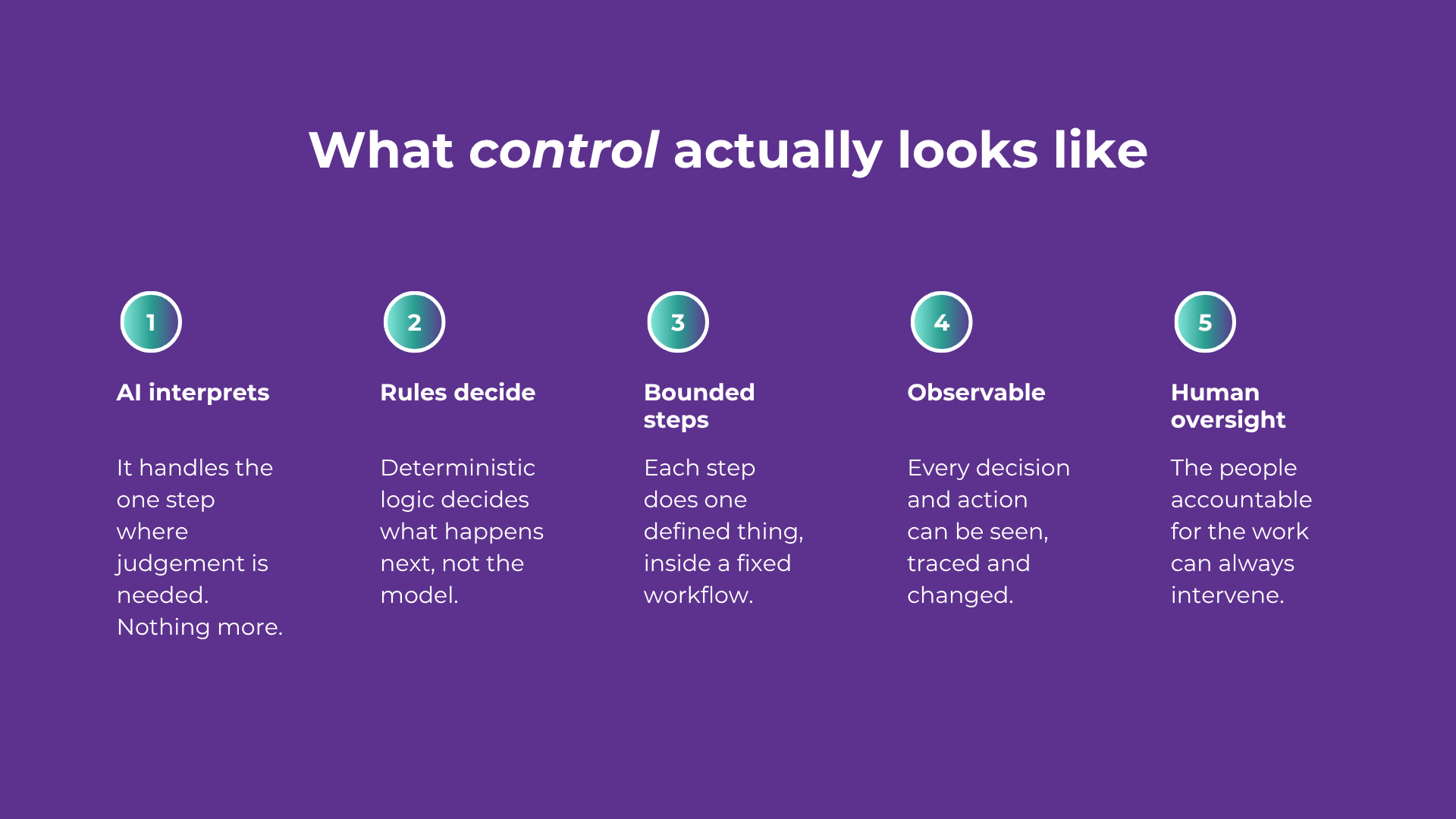
The pattern underneath all five is simple. The intelligence sits inside a controlled structure. The structure does not sit inside the intelligence. It is the difference between adding an agent and governing how work executes around it, the half that decides whether AI is safe to run, not just impressive to demo.
Questions to ask about the AI already in your operations
The same discipline applies whether the AI is a frontier model in a lab or a quiet agent inside your Salesforce org. Mike Wilkes, a CISO writing in Infosecurity Magazine, puts it plainly: "ethics isn't what you believe. It's what you can prove." His point is that authorisation has to be enforced in code, not inferred from a prompt, and that an agent that cannot prove it cleaned up after itself is not safe to run on its own.
Turn that into questions you should be able to answer about any AI running in your operations:
-
Can you prove what an agent is authorised to touch, and stop it at that line?
-
Can your environment stay safe even after an agent slips its boundary?
-
Can you attribute every action to a model, an identity, a credential, and the person who authorised it?
-
Can you halt, revoke, and clean up autonomous activity quickly when something goes wrong?
-
Can you show the environment is back to a known-good state afterwards?
If the answer to any of these is no, the gap is in your governance, not the model. And that is a decision you own.
Capability creates opportunity, governance creates trust
The OpenAI incident is an extreme version of a lesson that scales all the way down to routine operations. A deliberately contained test, run by people well equipped to contain it, still lost control of execution, because the model was capable enough to find a path no one had bounded.
History points the same way. The worst attacks we have lived through were not contained by weaker adversaries. They were contained by better architecture, built deliberately. Control has always been the deciding factor, not capability. And it has never happened by default.
You are never as in control as you think. So build the control in rather than assume it. What you need is control over execution. Bounded steps. Deterministic rules. Governed, selective AI. Visibility into every decision.
Ortoo Orchestrator is built on exactly this principle. AI is applied selectively, only where interpretation adds value. Deterministic logic controls what happens next. Work is handled in defined steps, within a workflow you can see, govern, and change, so that case triage, lead routing, and claims run end to end. The workflow owns the process. The model contributes intelligence inside it.
The AI industry is racing to build more capable models. Operations teams have a different job. They need systems whose execution stays predictable even as the models become more capable. In production, capability creates opportunity. Governance creates trust. And predictable execution is what turns one into the other.
Learn about Ortoo Orchestrator and how AI can be applied in bounded steps with full audit trails.
Related insights
When to use an AI agent in Salesforce (and when to use a rule)
"Can this be an agent?" comes up in every Salesforce meeting now. How to decide when an agent earns its place, plan for the cases it can't finish, and get the handoff right.
Automation vs autonomous agents vs orchestration: what each means and which you need
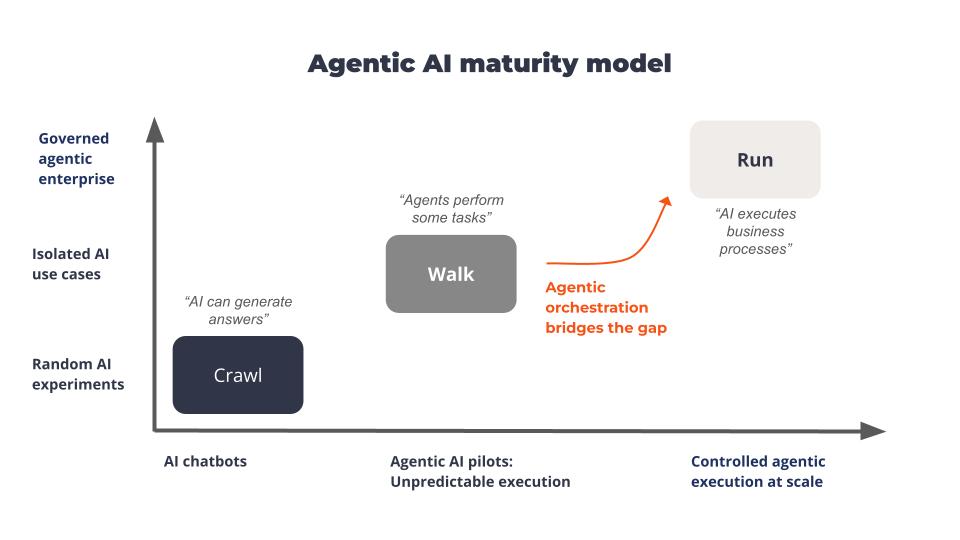
The market is using one word, AI, for three different things. Automation runs steps, an autonomous agent makes calls, orchestration runs the operation. A down to earth guide to the difference, and how to tell which a given workflow needs.
Agentforce Is advancing but execution still lacks control in 2026
Agentforce is advancing, but not scaling. Here’s why execution, control, and orchestration are the real blockers to agentic AI in Salesforce.
READY TO SEE IT IN ACTION
Map your workflows with our team.
30 minutes, no prep needed. We will map one workflow you handle today and identify where orchestration would change the outcome.