Why orchestration matters in Salesforce now
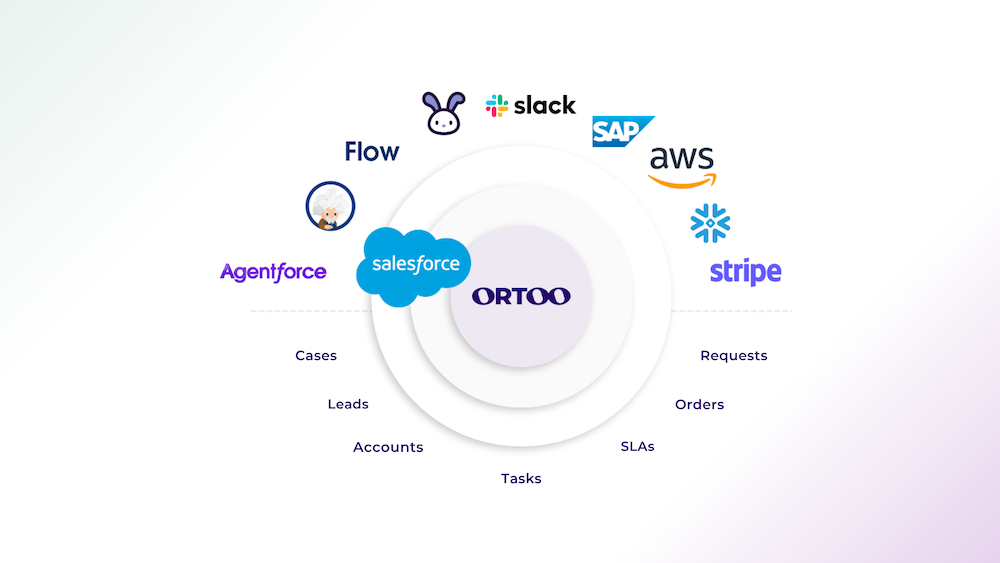
Salesforce is moving from CRM automation to agentic execution. Flows, routing, integrations, and now agents all become callable. The pieces keep multiplying. What has not kept pace is control over how all of it executes together.
That gap is where work gets stuck. Cases bounce between teams. Routing breaks. People step in to fix things by hand. Adding more automation does not close the gap. It widens it.
This is the real shift in Salesforce today. The hard part is no longer adding capability. It is controlling how that capability executes, end to end, with results you can predict.
More agents raises the stakes, not lowers them
Agents are easy to demo. They are harder to govern inside real operational workflows. An agent can read a request well and still hand work to the wrong place, take an action you did not intend, or do something you cannot trace after the fact.
The production question is not whether AI can act. It is whether the business can control when it acts, what it can touch, what happens next, and what it costs. Controlled, purpose-built access beats exposing everything and trusting the model to behave.
That is what orchestration handles. It defines how a workflow executes step by step. AI is applied where interpretation helps. Deterministic logic governs the decisions and actions that must be reliable. Every step stays visible and traceable. Work is handled the same way every time, even when AI is involved.
Orchestration is the next control point in Salesforce
As flows, APIs, integrations, routing rules, and agents all become callable, the risk is not a lack of capability. It is fragmented execution. Someone still has to define the sequence, the conditions, the handoffs, the exceptions, and the controls. Without that, every new agent and automation adds another moving part no one fully governs.
That is the role Ortoo Orchestrator now plays: the Salesforce-native layer that defines how AI, automation, routing, integrations, and teams execute together, with control.
A new chapter, and a clearer name
For more than 15 years, Ortoo has helped teams get a grip on operational work in Salesforce, from routing and triage to assignment and the multi-step workflows that service and revenue teams rely on every day.
Routing was the first place this problem showed up. But the deeper issue was always execution: how work is handled, changes hands, triggers actions, escalates, and completes across Salesforce. The same foundation now runs complete workflows, with specialized agents handling each step, AI interpreting where it helps, and clear rules governing the rest.
Ortoo is still Ortoo. What is new is the system that ties this together: Ortoo Orchestrator. Agentic workflow orchestration, built natively in Salesforce. Capabilities you may already know, like Q-assign and Email-to-Anything, are now part of it. Same team, same focus on control and governance, with a refreshed look to match.
What this means for your team
Orchestration is not a bigger automation project. It is a way to make the systems you already have run as one.
-
You keep your Salesforce investment. Orchestrator runs natively on your objects, flows, and APIs, and calls external systems when a workflow needs them.
-
You adopt AI with control. Decide where it is used, which model runs, what it is allowed to touch, and what it costs. Pilots reach production because the workflow around the AI is structured enough to run it predictably.
-
You start small. Fix one workflow first, see the outcome, expand from there. No big-bang change.
The result is steadier operations: predictable execution, controlled AI usage, fewer manual fixes, and clearer governance over how work is handled.
We are not changing direction. The market has caught up to the problem we have been solving for years. The name simply makes our role clear.
See where it goes next: www.ortooapps.com
Related insights

Ortoo at Dreamforce 2026: AIforce, customer conversations, and what's next
Ortoo's Dreamforce 2026 recap: AIforce, customer workshops, community catch-ups, and what we heard about oversight as agents take on more work.
Claudeforce: what's new, what isn't, and what it doesn't answer
Claudeforce makes Salesforce more accessible to AI. The bigger question is what happens next: who owns the work, which rules apply, when humans step in, and how actions are coordinated across systems.
When to use an AI agent in Salesforce (and when to use a rule)
"Can this be an agent?" comes up in every Salesforce meeting now. How to decide when an agent earns its place, plan for the cases it can't finish, and get the handoff right.
READY TO SEE IT IN ACTION
Map your workflows with our team.
30 minutes, no prep needed. We will map one workflow you handle today and identify where orchestration would change the outcome.