Mastering Salesforce Multi Team Handoffs Without Losing Control

Organisations often misjudge where process friction truly lies. They invest heavily in optimising individual tasks within a team’s silo, believing speed equals efficiency. The real bottlenecks, however, appear at the transition points between teams. The primary challenge in complex Salesforce multi-team handoffs – such as moving a case from service to legal, or an opportunity from sales to finance – is not the work itself. It is the transfer of ownership, context and data.
Consider a financial services firm in the UK handling a high-value client onboarding. The process moves from a compliance team verifying identity, to an account setup team provisioning services, and finally to a relationship manager. Each handoff is a potential point of failure. If information is lost or context is misunderstood, the entire workflow stalls. This is where thoughtful Salesforce workflow design becomes critical. Poorly managed transitions create a chain reaction of delays and ambiguous accountability that undermines the entire process. The problem is not that teams are inefficient; it is that the connections between them are fragile.
The True Cost of Ambiguous Handoffs
When a process relies on ambiguous handoffs, the costs extend far beyond simple delays. The first significant consequence is the creation of deep data silos. When a record arrives in a new queue without its full history, the receiving team is forced to become detectives. They spend valuable time hunting for information across related objects, emails and notes just to understand the current state of play. This rediscovery work is pure operational drag, introducing inconsistencies and slowing down every subsequent action.
The second cost is a complete breakdown of accountability. Without a clear owner at every stage, tasks are frequently dropped. A case might sit in a queue for days because no one is explicitly responsible for the next step. When deadlines are inevitably missed, it becomes nearly impossible to diagnose where the process failed. Was it the initial team’s fault for not providing enough information, or the receiving team’s for not acting on it? This lack of clarity is more than an inconvenience. At scale, it directly increases case resolution times, introduces serious compliance risks – a key concern for regulated UK industries – and degrades the quality of service delivered to the end customer. The problem is not a minor inefficiency; it is a fundamental flaw in operational integrity.
An Orchestration Model for Seamless Transitions

To fix broken handoffs, teams need to move beyond simple notifications and adopt a deliberate Salesforce process orchestration strategy. This approach treats each transition as a distinct, managed stage rather than an informal transfer. A robust model for this contains three core elements that ensure clarity and control.
Defining Clear Ownership Gates
First, the process must enforce single, accountable ownership for each phase. Using stages and interactive steps ensures a record cannot advance until the current owner completes their required actions and formally passes control. This is not just about updating a status field. It is a structured gate that prevents work from falling into an accountability vacuum. The responsibility is always clear and logged.
Creating a ‘Data Passport’
Next, you must create what can be thought of as a ‘data passport’. This concept involves packaging all necessary data and context to travel with the record as it moves between teams. Instead of forcing the next person in the chain to hunt for information, the passport delivers it directly. This includes key fields, critical case notes, related files and a full approval history. The goal is to give the receiving team everything they need to act immediately, without ambiguity.
Using Decision Points for Dynamic Routing
Finally, the handoff itself should be intelligent. By building decision logic into the workflow, work can be routed automatically based on record data – such as case priority, contract value or region. This ensures the handoff always goes to the correct team or individual without manual intervention, reducing errors and delays. As Salesforce’s own documentation on the Salesforce Admin Blog highlights, tools like Flow Orchestration are designed to unify complex, multi-user processes without code. This model turns a chaotic handoff into a predictable, controlled and efficient transition. For those looking to improve their wider operational frameworks, exploring different approaches to business operations can provide valuable context.
| Attribute | Traditional Handoff (Notification-Based) | Orchestrated Handoff (Stage-Based) |
|---|---|---|
| Ownership | Ambiguous; often relies on email or Chatter notifications | Explicit; assigned to a single user or queue per stage |
| Data Context | Fragmented; requires manual search across records | Packaged; travels with the record as a ‘Data Passport’ |
| Process Flow | Static and linear; manual intervention needed for exceptions | Dynamic; uses decision logic to route work automatically |
| Accountability | Low; difficult to track where a process stalled | High; progress is gated and ownership is logged at each step |
| Error Handling | Reactive; failures are discovered after the fact | Proactive; validation rules and clear stages prevent errors |
Identifying Handoff Failure Before It Scales
To manage complex workflows, you need a clear signal to detect failing handoffs before they cause systemic backlogs. The most effective metric is not overall resolution time, but the ‘Time-in-Stage’ duration for each handoff point. While a high-level KPI might hide underlying issues, this granular metric exposes the exact location of a bottleneck with precision.
Tracking how long a record sits in a specific status – like ‘Awaiting Triage’ or ‘Pending Finance Approval’ – reveals where friction is building up. Is one team consistently overwhelmed? Is a specific approval step taking longer than expected? This data provides the answers. You can use standard Salesforce reports and dashboards to visualise this metric effectively. For instance, a grouped report on cases by status, combined with a summary-level formula calculating the average duration, can quickly highlight problem areas on a dashboard.
This approach allows operations leaders to move from reactive problem-solving to proactive process improvement. By monitoring the time spent at each transition, teams can identify and fix issues in their Salesforce multi-team handoffs before they compromise service delivery. It provides a practical diagnostic tool to maintain workflow health.
Maintaining Control as Processes Evolve

Effective Salesforce multi-team handoffs depend on deliberate design, clear ownership and controlled transitions – not just automation speed. By focusing on the handoff points as critical process stages, organisations can build scalable, resilient workflows that prevent data silos and maintain end-to-end accountability. This structured approach ensures that as your business grows and processes change, control is never lost.
For teams evaluating how to implement these models, a practical demonstration can clarify the approach. You can request one by emailing sales@ortooapps.com.
Ask an Expert any question about designing Salesforce workflows for complex multi-team handoffs by emailing sales@ortooapps.com.
Related insights
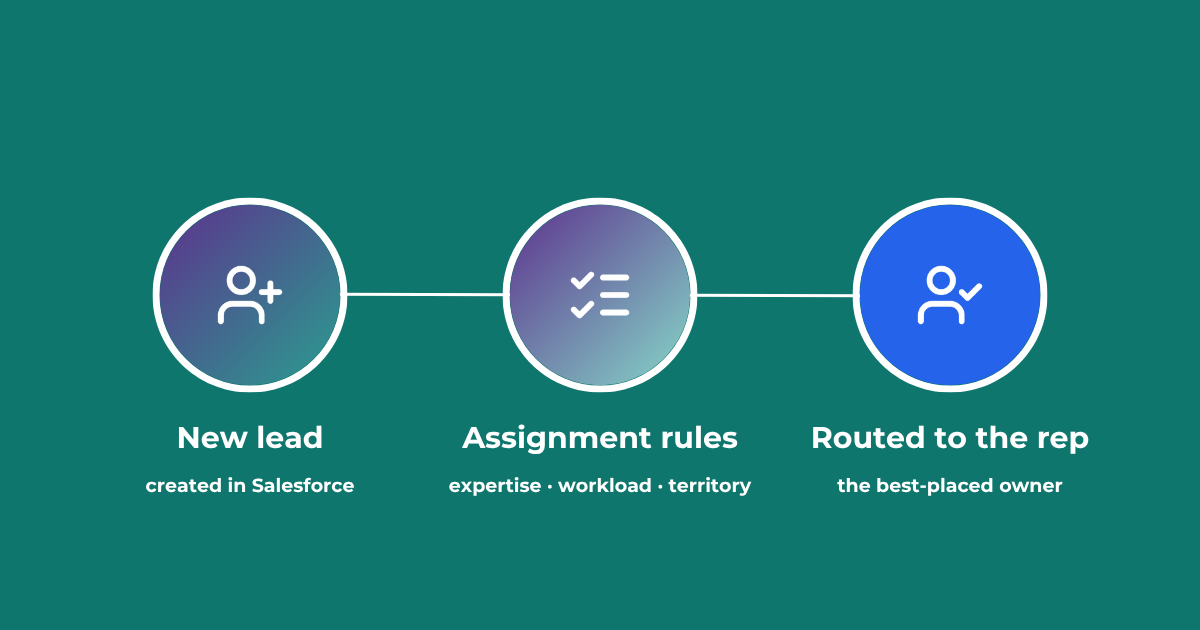
Lead Assignment Rules in Salesforce: Automate with Q-assign
This comprehensive guide to optimizing lead assignment rules in Salesforce will stand you in good stead for maximizing your sales reps’ productivity and performance. Understand the benefits of highly effective lead assignment, explore Salesforce best practices and stay ahead of the competition – with added insights into AI-driven revenue orchestration
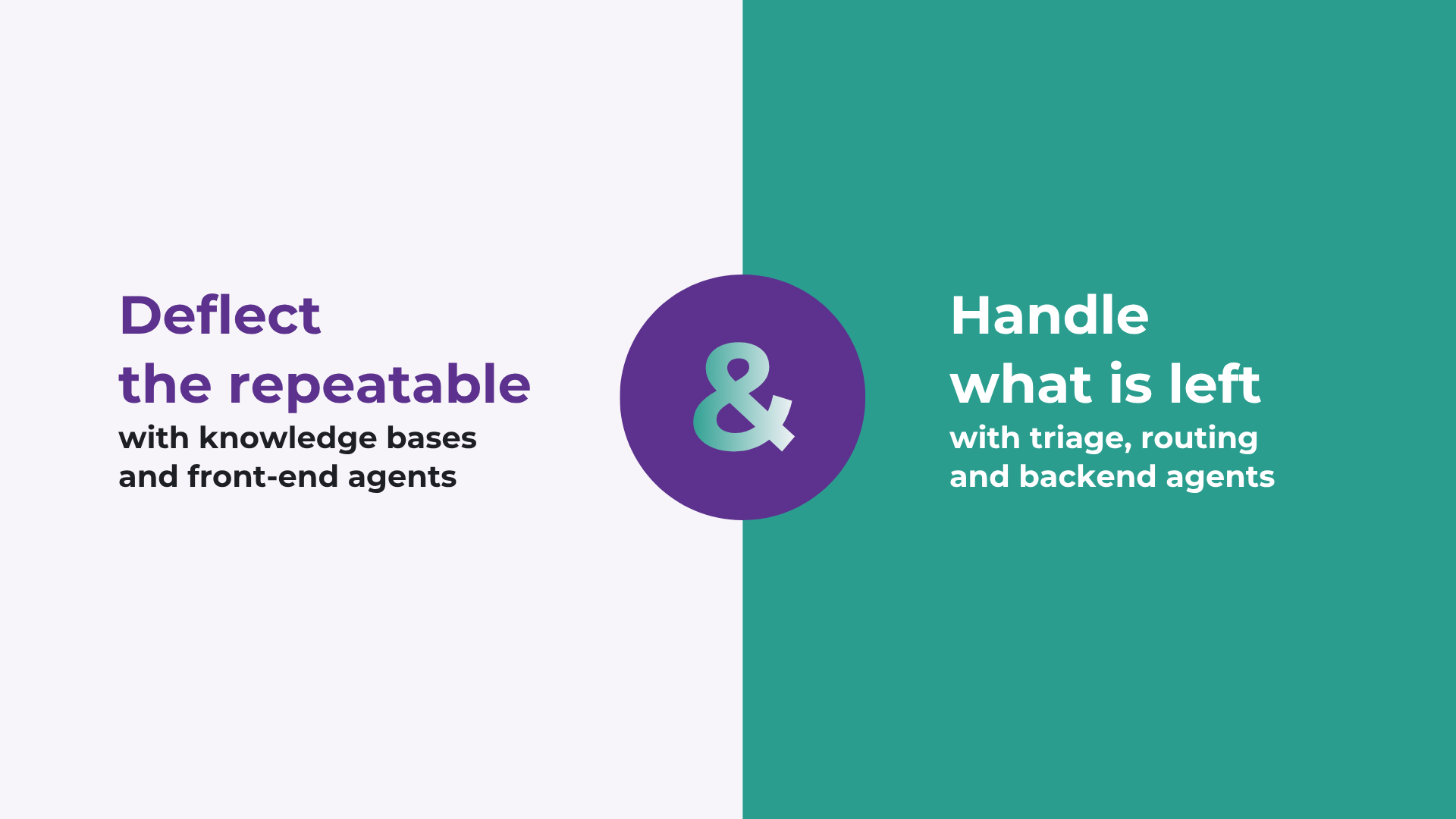
How to improve Salesforce case deflection rates
Deflection only solves half the problem. The cases that do not deflect are the ones that breach SLA. How to improve deflection rates, and how to handle what is left.

Calling Salesforce is easy. Defining what happens next is the hard part.
Salesforce workflows don’t break because of missing automation. They break because no single system defines what should happen. Here’s what actually fixes it.
READY TO SEE IT IN ACTION
Map your workflows with our team.
30 minutes, no prep needed. We will map one workflow you handle today and identify where orchestration would change the outcome.