Agentforce editions: what is actually in Core, Advanced and Max?

Salesforce now sells Agentforce in three editions. This guide sets out what Core, Advanced and Max each include, how far their Flex Credits go, and where Workforce Engagement stops and work assignment begins.
Choosing between them takes more than comparing the monthly price. You need to know how much agent activity your Flex Credits will support, which capabilities you will actually use and, if you run service operations, whether you need workforce planning, work assignment, or both.
Salesforce's new Agentforce editions are priced at $195 for Core, $395 for Advanced and $550 for Max per user per month. They include 500,000, 1 million and 2.75 million Flex Credits per org per year respectively.
All three editions include the same core bundle. Max is the tier that materially expands the operational package: it includes Workforce Engagement, IT Service and unmetered Agentforce Coworker access, several of which Core and Advanced can buy as add-ons.
| Core | Advanced | Max | |
|---|---|---|---|
| Price per user per month | $195 | $395 | $550 |
| Flex Credits per org, per year | 500,000 | 1,000,000 | 2,750,000 |
| Approx. standard actions at 20 credits per action | 25,000 | 50,000 | 137,500 |
| Workforce Engagement and quality management | Add-on* | Add-on* | Included |
| IT Service | Not included | Not included | Included |
| Unmetered Agentforce Coworker access | Add-on | Add-on | Included |
*Salesforce's Service pricing page lists workforce management and unmetered Coworker access as available to purchase on Core and Advanced.
Salesforce announced the three editions on 3 September 2026, consolidating a longer list of clouds and add-ons.
For buyers, the feature list is only the starting point. The more useful question is which operational problems each capability actually solves. For most existing customers, the first time any of this matters is renewal.
What does each Agentforce edition include?
Core, Advanced and Max all include Agentforce, Slack and Slackbot, Tableau Next, embedded agentic analytics, enterprise security and data protection, and a Premier Success plan.
Advanced adds a larger Flex Credit allowance and, according to Salesforce's Service pricing page, a full sandbox, Backup & Recover and Data Detect.
Max goes further. It includes:
- Workforce Engagement, including quality management
- IT Service
- Unmetered Agentforce Coworker access with a library of service agent templates
On Core and Advanced, workforce management and unmetered Coworker access are listed as available to purchase rather than included.
Max costs $550 per user per month, the same price as Agentforce 1 Edition. You may also see it called the AIforce Max edition, the name used in Yahoo Finance's coverage of Salesforce's Investor Day.
That makes Max a substantially broader operational bundle. One distinction matters if you are evaluating it for service operations: workforce management and work assignment are different jobs.
How do Flex Credits work?
Flex Credits meter Agentforce activity by action.
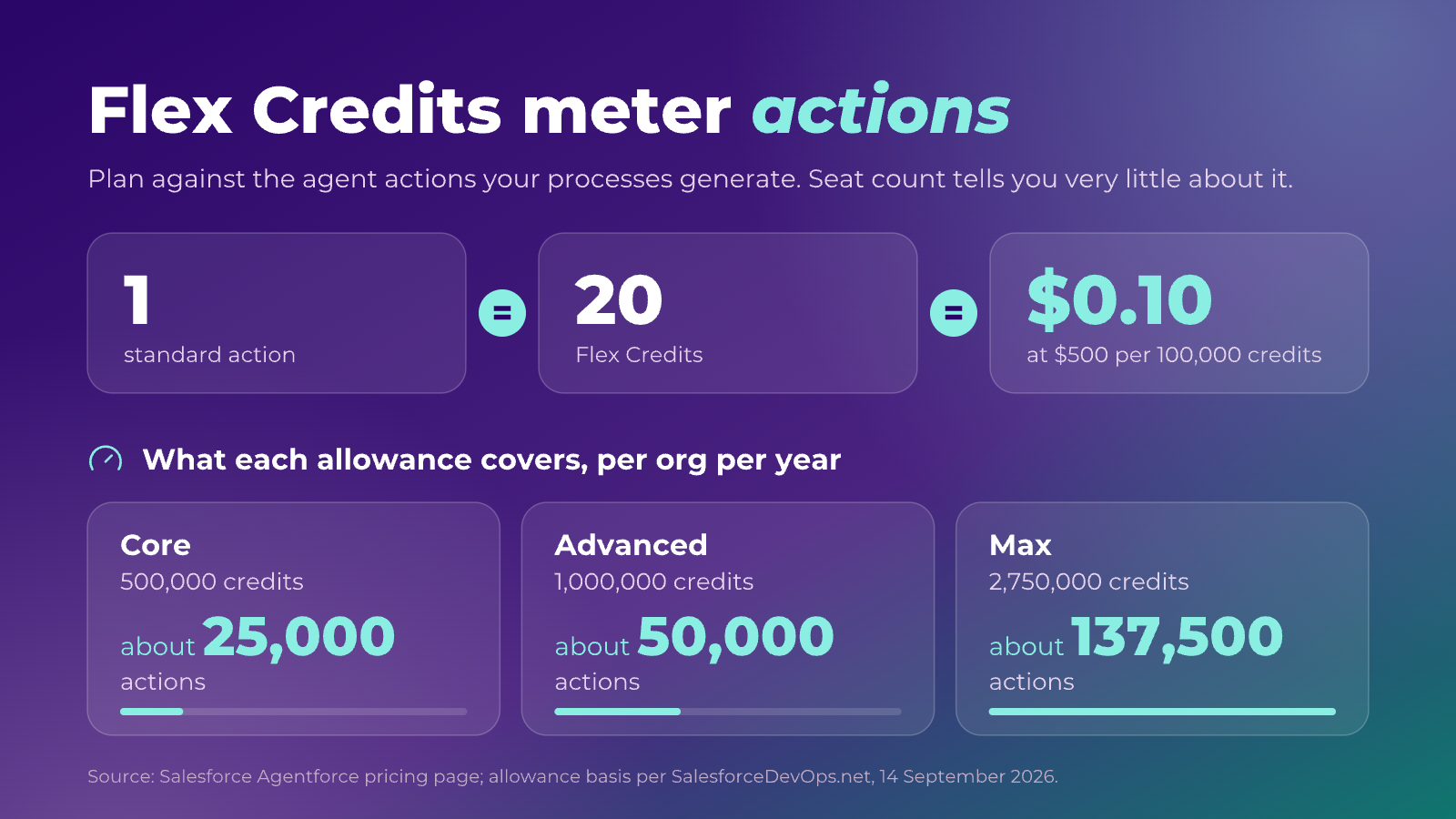
One standard action consumes 20 Flex Credits. At Salesforce's list rate of $500 per 100,000 credits, that equates to 10 cents per standard action.
Salesforce's Agentforce pricing page gives the same worked model: two standard actions consume 40 credits; five consume 100.
The allowances are per org per year, as SalesforceDevOps.net reported on 14 September 2026. They translate approximately to:
- Core: 25,000 standard actions a year
- Advanced: 50,000 standard actions a year
- Max: 137,500 standard actions a year
So estimate the number of agent actions your processes are likely to generate. A workflow with 3 agent actions consumes credits differently from one with 12, even if the same number of employees use it.
Your expected action volume is a more useful sizing input than user count alone. For a worked cost model and why different kinds of AI work need different pricing, see AI pricing should be simple to understand and granular to control.
What do the new editions mean at renewal?
For most existing customers, the new editions matter first at renewal. Salesforce says existing customer pricing on legacy editions remains unchanged, and it has not confirmed what happens to Enterprise and Unlimited when those contracts come up.
That conversation reaches a large part of the customer base. On Salesforce's earnings call on 26 August 2026, President and COO Miguel Milano said only 5% of the knowledge workers using Sales and Service had upgraded to the higher-end editions, as reported by Enterprise Dreamin.
Salesforce positions each new edition against a legacy one. UpperEdge's analysis of the new editions sets the list prices side by side.
| Legacy edition | List price | Nearest new edition | List price | Salesforce's value claim |
|---|---|---|---|---|
| Enterprise | $175 | Core | $195 | 70% more value |
| Unlimited | $350 | Advanced | $395 | More than 50% more value |
| Agentforce 1 | $550 | Max | $550 | 60% more value, upgrade at no extra cost |
Prices are per user per month. The pairings reflect how Salesforce frames its value comparison. Salesforce has not said that a legacy edition converts to its pair at renewal.
Since the launch, discussion among Salesforce partners and admins has kept returning to the same questions:
- What do our current entitlements become under the new editions?
- How do we forecast Flex Credit consumption, when an action count is harder to predict than a seat count?
- Are we already paying for capabilities we do not use, and would staying where we are be the better answer?
Those are the right questions to bring to a renewal. Start by mapping what your teams use today, capability by capability, before comparing what each edition adds.
What does Agentforce Workforce Engagement do?
Workforce Engagement helps you plan and manage a contact centre workforce.
Salesforce launched Contact Center Workforce Engagement Management on 22 June 2026. It has three main components.
| Component | What it does |
|---|---|
| Command Center | Gives supervisors a consolidated view of service operations, workforce metrics and observability across AI agents and human representatives |
| Workforce management | Uses workload histories to forecast demand, create capacity plans, schedule shifts around skills and constraints, manage intraday changes and monitor adherence |
| Quality management | Evaluates voice, messaging and case interactions. Automated Quality Management can score completed or transferred conversations using scorecards and confidence scores |
Those are meaningful capabilities. For organisations using a separate workforce management platform for forecasting, scheduling or quality management, having them inside Salesforce can make Max particularly relevant.
Workforce Engagement answers a specific set of questions:
- How many people will we need?
- Which skills need to be available?
- Who should be working at a particular time?
- How well did the interaction go?
There is another operational question it leaves to a different layer.
Does Workforce Engagement assign individual work items?
Workforce Engagement does not route individual records to individual people.
It can use Omni-Channel queue data as an input to workforce forecasts, and the actual assignment of work still sits with assignment rules, Omni-Channel or another routing layer.
The distinction is easy to miss because workforce planning and routing share much of their vocabulary: capacity, skills, availability, workload and queues. They operate at different levels.
Salesforce's capacity planning documentation describes a capacity plan as predicting the coverage required in a service territory over a given timeframe. Forecast volumes and average handling times help determine how many people need to be available.
That answers a workforce question. Work assignment answers a question about one piece of work:
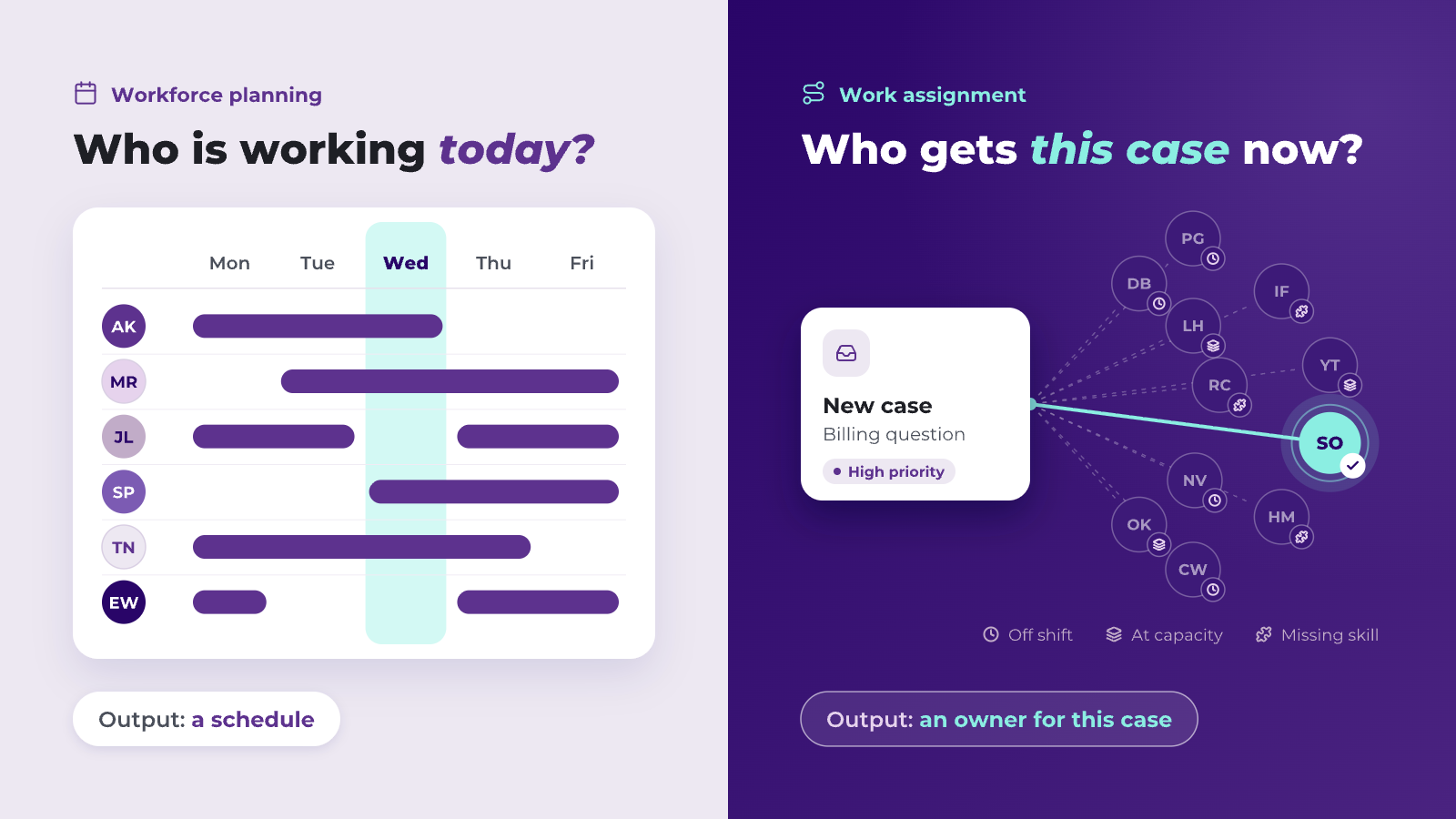
A case has just arrived. 11 people could potentially handle it. Who should get it now?
That case assignment decision may depend on live workload, product expertise, availability, working hours, territory, quotas, priority, SLA state and your own business rules.
Put simply, forecasting tells you how many people you need. Scheduling tells you who is working. Routing decides who gets this piece of work.
So "we have Workforce Engagement with Max" and "our work assignment is covered" are two separate statements. Check them separately.
What should you check before choosing an Agentforce edition?
Before choosing Core, Advanced or Max, pressure-test five things.
- How many agent actions will your processes actually generate? Map several representative workflows and count the likely actions. A credit allowance means little until you have an estimate of consumption.
- Do you need workforce planning, work assignment, or both? If the requirement is forecasting, scheduling and quality management, Workforce Engagement addresses it. If the requirement is deciding which person receives each incoming case, lead, task or other work item, examine your routing layer as well.
- What happens when the roster is right but the assignment is wrong? Someone can be scheduled, logged in and qualified, and still already be carrying too much work. Does your routing logic notice before the next record is assigned?
- Which of your current entitlements do you actually use? Map them before renewal. A higher edition bundles more, and the extra value only counts for the capabilities your teams will operate.
- Who can change the routing logic? Territories move, skills change, priorities shift and teams reorganise. Find out who can change those rules, how long a change takes, and whether routine operational changes need development or deployment work.
If routing is part of your evaluation, our guide to choosing Salesforce routing software looks at that decision separately.
When does Agentforce fit, and when does Ortoo Orchestrator?
Agentforce fits best when the main job is conversational: agents that answer, draft and resolve requests, sized by seats and Flex Credits. Ortoo Orchestrator fits best when the main job is operational: high volumes of cases, leads and requests that have to be classified, assigned, escalated and completed under your own rules.
Some teams need both. Many need only one.
Agentforce alone is often enough when:
- Most of the value sits in customer conversations and employee assistance.
- Routing is simple, and Omni-Channel and assignment rules already handle it well.
- You will use what Max bundles, such as Workforce Engagement, IT Service and Coworker access.
Ortoo Orchestrator is the better fit when:
- Work volume is high, and each case or lead passes through several steps.
- You want AI applied only to the steps that need judgement, with deterministic logic handling the rest at no AI cost.
- You want to forecast cost per work item such as a case or a lead, not per seat or per agent action.
- You want to choose your own model provider and use your own API key.
- Assignment depends on live workload, skills, availability, quotas and territory, and the rules change often.
| Agentforce editions | Ortoo Orchestrator | |
|---|---|---|
| Main job | AI agents for conversations and assistance | Orchestrating operational work from intake to resolution |
| What you pay for | Seats, plus Flex Credits per agent action | Each work item such as a lead or a case |
| Steps that don't need AI | Metered as agent actions when an agent performs them | Run as deterministic logic, with no AI cost |
| Assignment | Omni-Channel and assignment rules | Q-assign, using live workload, skills, availability, quotas and territory |
The two also work together. Agentforce agents can handle the conversation while Ortoo Orchestrator runs the work behind it. Ortoo Orchestrator can equally run on its own, as the layer that handles intake, classification, assignment, escalation and resolution. Both are Salesforce-native, so either way the work stays inside your org.
Q-assign, the routing engine within Ortoo Orchestrator, assigns Salesforce records using live workload, skills, availability, quotas and territory, and reassigns them as circumstances change.
Workforce planning is a separate decision. Workforce Engagement plans who is working. Ortoo Orchestrator decides what happens to each piece of work once it arrives.
To see how it handles a case from intake to resolution, explore Ortoo Orchestrator.
Agentforce editions: frequently asked questions
Is Salesforce retiring the Enterprise and Unlimited editions?
Salesforce has not confirmed it. It describes Enterprise as a legacy edition and says existing customer pricing on legacy editions remains unchanged, but it has not announced an end-of-sale date.
Do existing customers have to move to Core, Advanced or Max at renewal?
Salesforce has not said so. Its announcement states that existing customer pricing on legacy editions remains unchanged, so what is offered at your renewal is a question for your account team.
What happens if you use more Flex Credits than your edition includes?
There is no overage penalty. Usage above your entitlement is billed monthly in arrears at your contracted rate, and Digital Wallet tracks consumption in near real time with threshold alerts.
Do unused Flex Credits roll over?
No. Salesforce's pricing page states that unused Flex Credits do not roll over into subsequent subscription terms.
Can existing Agentforce 1 customers move to Max?
Yes. Salesforce says existing Agentforce 1 Edition customers can upgrade to Max at no extra cost, and that Max delivers 60% more value than Agentforce 1 at the same price.
Does Agentforce Max include quality management?
Yes. Quality management is one of the three components of Workforce Engagement, which is included in Max. On Core and Advanced, Salesforce lists workforce management as available to purchase.
Sources
Pricing and packaging checked against the sources below on 19 October 2026.
- New Salesforce editions bundle everything businesses need for agentic transformation, Salesforce (3 September 2026)
- Service pricing, Salesforce (edition contents and add-ons, updated 2 October 2026)
- Agentforce pricing, Salesforce (Flex Credit rate, worked examples, overage and rollover terms)
- Sales Cloud is back on the price list, SalesforceDevOps.net (14 September 2026)
- Salesforce Investor Day unveils AIforce, Claudeforce and $63B FY2030 revenue target, Yahoo Finance (September 2026)
- Do Core, Advanced and Max replace Enterprise?, Enterprise Dreamin (updated 17 September 2026; quotes the Q2 FY2027 earnings call of 26 August 2026)
- Salesforce new editions: pricing, bundling and negotiation strategy, UpperEdge (23 September 2026)
- Salesforce pricing keeps changing, Salesforce Ben (28 September 2026)
- Smarter staffing, better coaching: introducing Contact Center Workforce Engagement Management, Salesforce (22 June 2026)
- Quality Management, Salesforce Help
- Admin checklist for capacity plan setup, Salesforce Help
- Data in an Omni-Channel queue-based workflow, Salesforce Help
Related insights

AI pricing should be simple to understand and granular to control
Seats suit AI assistants. High-volume operational AI needs pricing per task and granular control. What Agentforce editions show about pricing AI by how it's used.

Centralising Salesforce Routing Logic Without Fragile Code
Understand the limits of custom code and flows for routing and discover a more resilient, centralised model.

AI-Powered Round Robin Assignment in Salesforce
Discover how AI-powered round-robin Salesforce assignment drives efficiency for management of Leads, Cases, and more. This article explores the capabilities and limitations of Salesforce-native round-robin functionality and how AI can plug the gaps.
READY TO SEE IT IN ACTION
Map your workflows with our team.
30 minutes, no prep needed. We will map one workflow you handle today and identify where orchestration would change the outcome.