    SupportContact

    How Ortoo Orchestrator executes work in Salesforce, from intake to audit trail.

    Native to Salesforce. Part AI, part deterministic rules. You change how work is handled without code, and the audit trail never breaks.

    More tools, more AI, more sprawl. The same team absorbing all of it.

    The pieces are all there. The system is not.

    Salesforce gave you the pieces. Flow, Apex, routing rules, queues, Agentforce. Each one was added to solve a specific problem. A decade in, you have all the pieces. What you do not have is a system that runs them as one.

    Adding AI hasn't simplified anything.

    Each new use case adds another tool, another integration, another place where decisions happen without coordination. Here is what that looks like in practice:

    Flows

    Configured by admins, owned by individual teams, hard to inventory across the org.

    Routing rules

    Tied to specific objects, hard to coordinate across workflows.

    AI tools

    Added per use case. No shared context, no shared governance.

    Integrations

    Apex callouts, point-to-point connectors, custom middleware. Fragile.

    Each piece does its job. Together, they cannot be trusted to run as one.

    Ortoo Orchestrator runs your Salesforce workflows end to end, predictably, and under your control

    You configure workflows once.

    Specialist agents, each owning one stage. None of them improvise.

    Every step is traceable.

    Costs align to outcomes, not to activity.

    Architecture

    The system behind every case, lead, and request.

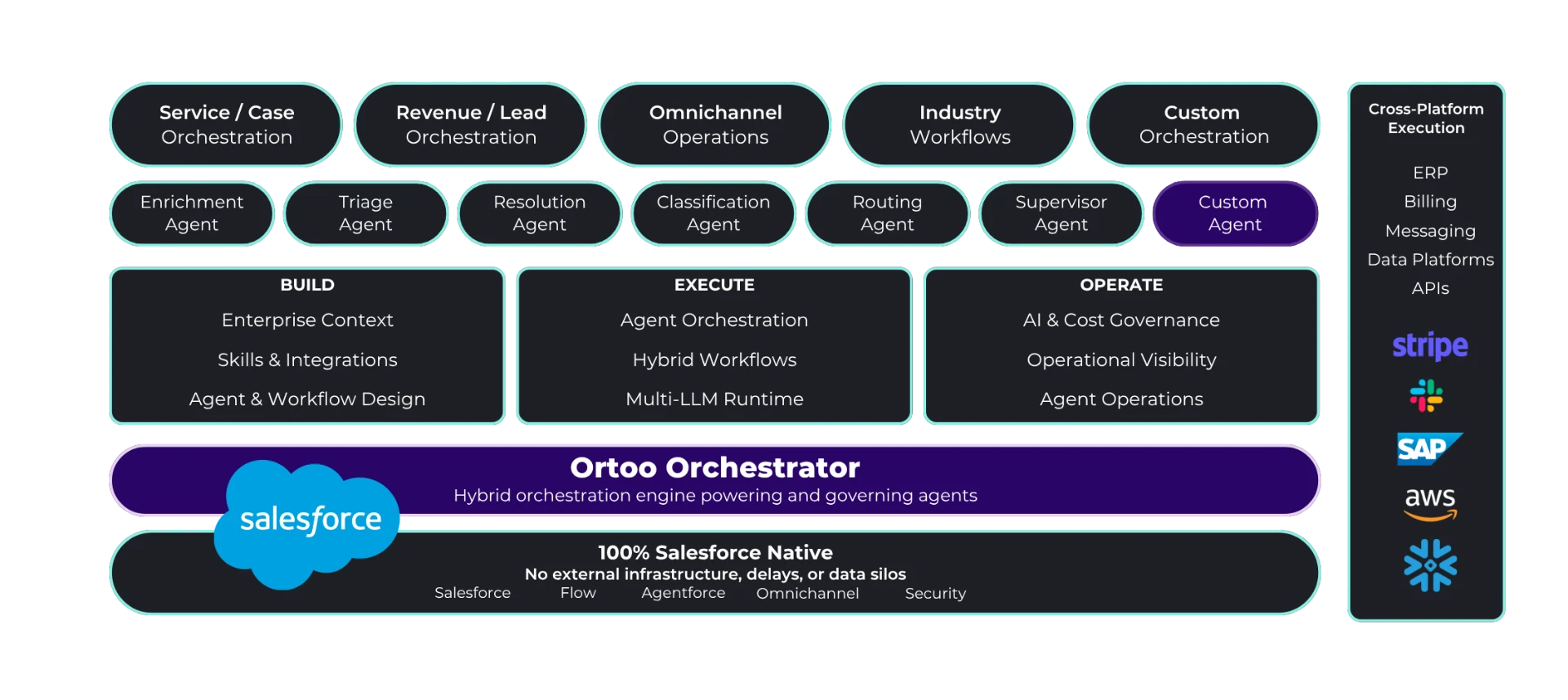
    Each layer with a defined job: the workflows your team runs, the agents that handle each stage, the capabilities they are built from, the engine that coordinates them, the Salesforce-native system they run inside, and the external platforms they reach across.

    Ortoo Orchestrator architecture: workflows, operational agents, capabilities, and the orchestration engine.

    Workflows

    What your team runs.

    Cases get handled. Leads get routed. Renewals get triggered. Documents get processed. Whether it is a standard solution or a workflow your ops team configured, this is what the rest of the system exists to run.

    Operational agents

    Who handles the work.

    Each workflow runs through specialist agents with defined roles: triage, enrichment, classification, routing, resolution, supervision. Each agent handles one stage. None improvise. Together they run the workflow end to end.

    Capabilities

    What agents are built from.

    Three groups. Build covers access to your Salesforce data, records, skills, and integrations. Execute covers agent orchestration, hybrid workflows, and multi-LLM runtime. Operate covers AI cost governance, live workflow status, and monitoring.


    Engine

    What coordinates it all.

    Hybrid orchestration that coordinates agents, workflows, AI calls, and integrations. AI runs where interpretation helps. Deterministic logic governs the rest.

    System

    Where it runs: 100% Salesforce native.

    Runs inside your Salesforce org, under your existing permissions, Flows, and Apex. Composes with Agentforce and Omnichannel. Your data stays in your systems, and you control where any model call goes.

    Cross-platform execution

    What workflows reach across.

    ERPs, billing systems, messaging platforms, data warehouses, APIs. Workflows run inside Salesforce, but reach across the systems your business depends on. Stripe, Slack, SAP, AWS, Snowflake, and any system exposed through an API.

    How it runs

    Every step is controlled. Every decision is auditable.

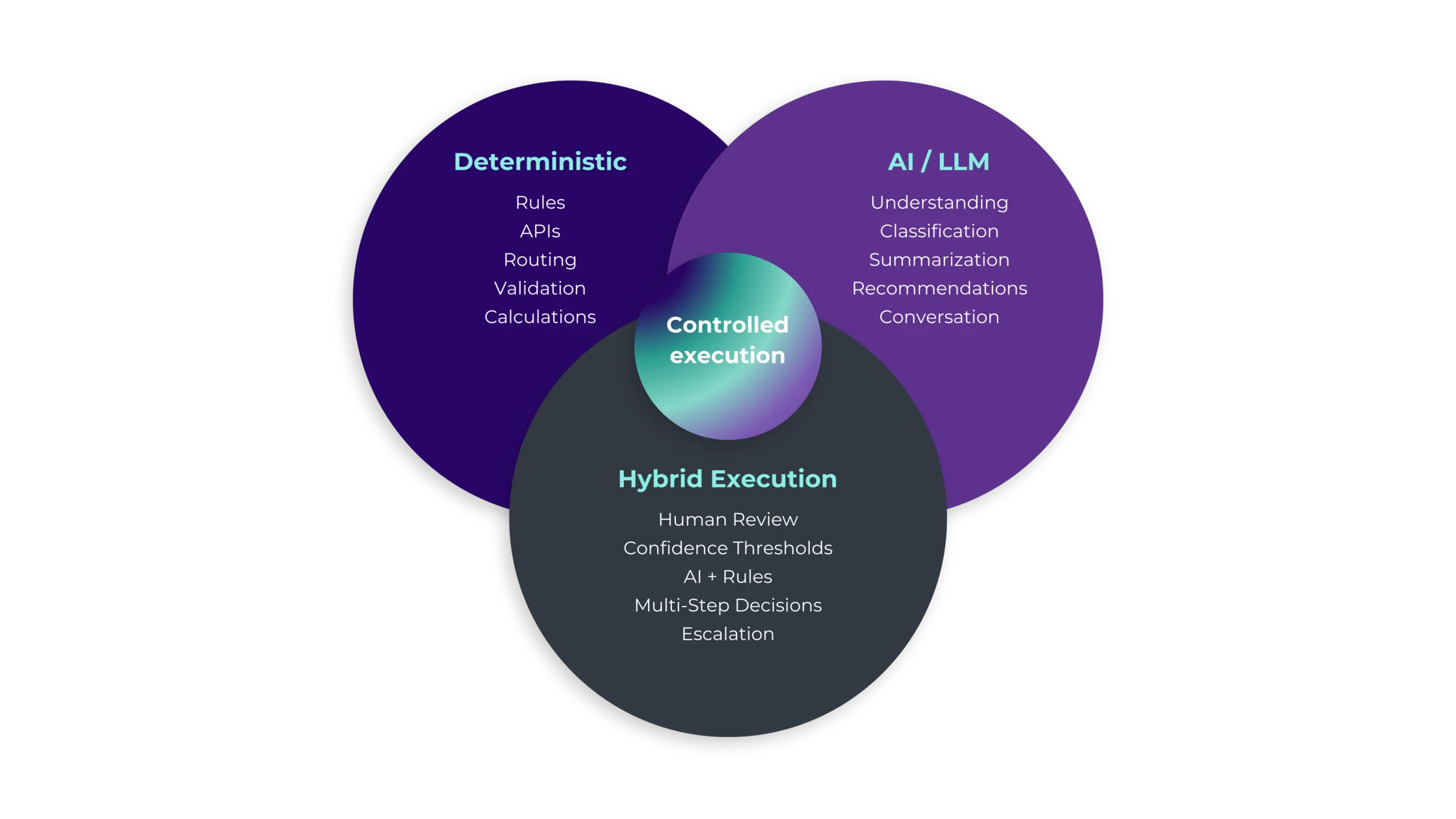
    Every workflow runs through the same execution model. At each step, Ortoo Orchestrator chooses between AI and deterministic logic, not across the whole workflow, but step by step. Your team decides where AI runs, which model, and under what governance.

    Hybrid execution diagram. AI interpretation steps and deterministic logic steps interleaved across one workflow.

    Trigger

    A workflow starts when a case arrives, a schedule fires, or an external system calls in. From Salesforce, from Agentforce, from a user.

    Context

    The agent at each step gets the data it needs: the case record, account history, related records, knowledge sources. Loaded at runtime based on what that step has to do.

    Steps

    Each step has one role. AI where interpretation helps. Deterministic logic where it does not. Each step runs through a specialist agent, a function, or a human approval.

    Agents

    Specialist agents handle each stage: triage, enrichment, routing, and resolution. Supervisor agents manage exceptions and escalations. Context passes between them at each handoff.

    Outcome

    Results write back to Salesforce. Records update, queues close, and the work is complete, or the next stage begins automatically.

    Audit

    Every step is logged: what ran, what was decided, what the agent saw, what the AI returned. Audit trails are queryable and exportable.

    Routing vendors handle one slice of one workflow. Ortoo Orchestrator handles the whole thing, from the trigger to the audit trail, defined and adjusted from the product UI, no code, no deploy cycle.

    See how Ortoo compares to Agentforce

    A real example

    Triggered by case context. Not by who is watching the queue.

    A workflow from a production deployment, from inbound case to closed, without a human making routing decisions.

    1. // STEP 01

      Identify the case context.

      Channel, priority, customer tier, region, and language are read the moment the case arrives. The triage decision that used to live in someone's head happens before the case ever reaches a queue.

    2. // STEP 02

      Match against live agent state.

      Skills, current workload, availability, and SLA targets are evaluated together against the rules your operations team configured. Capacity is real, not assumed. Senior agents are not routed work they cannot reach.

    3. // STEP 03

      Route, log, and escalate.

      The case is assigned. The decision is logged in Salesforce. SLA timers start. If the case stalls or no agent matches, the escalation path triggers automatically. No silent fall-through to a default queue.

    4. // STEP 04

      Apply context to the resolution.

      The resolution agent reads the case, pulls relevant articles from the knowledge base, and drafts a response. Your team receives a queue of judgment calls, not a flood of raw, unclassified tickets.

    5. // STEP 05

      Close the loop.

      Resolution writes back to Salesforce. The customer is notified through the channel the case arrived on. Every decision is in the audit trail.

    How workflows start

    Workflows start when work arrives, however it arrives.

    The same orchestrator handles every entry point. Your team does not build different workflows for different triggers. One workflow, many starts.

    01

    Record-triggered

    A case is created, a lead is submitted, a field changes. Workflows start in Salesforce without additional wiring.

    02

    Inbound from external systems

    Requests come in through APIs and connectors. The workflow starts from outside Salesforce and runs natively inside it.

    03

    Scheduled

    Cron-style recurrence for batch processing. Date-driven workflows for renewals, follow-ups, and policy checks.

    04

    On-demand

    Triggered by your ops team from a record, a list view, or a custom action. The same orchestration logic runs whether the trigger is automatic or manual.

    05

    Agent-initiated

    One agent finishes and triggers the next workflow. Workflows chain into longer sequences. Context carries between them.

    06

    External systems via MCP

    MCP-compatible agents and systems, including Agentforce, can call Ortoo Orchestrator's workflows directly. The workflow runs natively on Salesforce, even when the call originates outside it.

    Configuration

    Define it once. Your team reuses it everywhere.

    Every capability in Ortoo Orchestrator is built from a three-tier model. It is what makes the system configurable instead of coded, and why your operations team can change a workflow and go live the same day.

    See how agents compose tools
    01

    Function Definition

    The capability, defined once. Send Email. Create Jira Issue. Classify Case Priority. Each definition has a clear contract: what goes in, what comes out, what it does.

    02

    Function Instance

    A specific configuration of a definition. The Send Email function set up for the support team, with their templates and sender address. The same function set up separately for sales. Different settings. Same capability underneath.

    03

    Function Usage

    The use of an instance inside a workflow, agent, or prompt. The Triage agent uses the support team's Send Email instance. The Lead Follow-up agent uses the sales team's. Many usages of one instance. Many instances of one definition.

    No Apex. No deployment. No engineering queue. Your operations team adjusts workflows and goes live the same day.

    What it connects to

    The orchestration runs in Salesforce. The work it coordinates doesn't stop there.

    Ortoo Orchestrator runs natively on the Salesforce platform. When a case or request requires data or action from an external system, Ortoo reaches out, gets it, and brings it into the workflow. Your data stays in your systems.

    Salesforce native

    Flow, Agentforce, Omnichannel, queues, rules, permission sets. Used as building blocks. Coordinated by Ortoo.

    Business systems

    ERP, billing, data platforms, document stores. Reached through APIs and connectors. No data duplication.

    Team tools

    Slack, Microsoft Teams, email, internal apps. The places work continues outside Salesforce.

    Coordination engine

    Ortoo Orchestrator

    The coordination engine. Runs natively on the Salesforce platform. Coordinates intake, agents, decisions, approvals, and systems of record in one execution model.

    AI providers

    Any model. Any provider. Customer-managed keys. The model that runs at each step is your choice, configured per workflow.

    External APIs and webhooks

    Anything addressable by an API endpoint. Ortoo reaches out, gets the data, brings it into the workflow.

    MCP-compliant services

    Servers that implement Model Context Protocol. Standardised access to tools and data, governed by Ortoo's permission model.

    The orchestrator runs natively. The systems it reaches stay where they live.

    Pricing

    Pay per case handled. Not per token consumed.

    Most agentic platforms bill per action and per token. As activity scales, so does the bill, whether the work was completed or not. Ortoo bills per work item handled. Spend tracks outcomes, not activity.

    • A case handled, start to finish
    • A lead routed to the right owner
    • A request processed to completion
    • A renewal or approval executed
    Map your workflow

    Not pilots. Not POCs. Production.

    These workflows run at the center of service and operations functions, not as experiments.

    Automotive · Service operations

    Cars.com

    33,600 hours of manual triage, removed.

    33,600
    Hours reclaimed annually

    The Setup

    Cars.com runs a four-stage AI triage: classify, enrich, route, resolve, on every inbound case across the Dealer Inspire division.

    The Impact

    Before Ortoo, 25 senior agents spent 60% of their time on manual case triage, assignment, and follow-up. That is 2,800 hours monthly absorbed into work that should not have required senior judgment. After Ortoo, that time goes to high-value customer problem-solving. Volume runs at 14,000+ cases per month, processed with near 100% first-touch routing accuracy.

    16
    FTE equivalents freed
    168,000
    Cases handled per year
    6
    Production use cases
    Criticality 5
    AI rating, core to solution
    Service Cloud · Ortoo Orchestrator + Q-assign + e2a

    Compliance · Service operations

    Assent Compliance

    120,000+ records processed in three months.

    120,000+
    Records processed in 3 months

    The Setup

    Assent processes regulatory compliance work across 16 teams in the global supply chain compliance function.

    Scope

    Sixteen distinct use cases run on Ortoo Orchestrator, covering document intake, classification, exception handling, and multi-stage approval. The team operates across five languages (English, German, Polish, Chinese, and others) with cases routing automatically to language-specialist agents on arrival.

    Why It Matters

    AI is rated Criticality 5, Core to Solution, across nearly all use cases. The workflows cannot function without it. The Assent team continues to expand their use of AI services and actively requests new capabilities. The system is a roadmap input, not just a delivery mechanism.

    16
    Teams live
    16
    Production use cases
    5
    Languages routed
    Criticality 5
    AI rating, core to solution
    Service Cloud · Ortoo Orchestrator + Q-assign

    Common questions

    Questions architects ask.

    How does this work alongside Agentforce, Flow, and Apex?

    +

    Ortoo Orchestrator and Agentforce complement each other. Agentforce handles conversational interfaces and single-task assistance. Ortoo Orchestrator handles multi-step operational workflow execution. Agentforce can invoke Ortoo as an MCP server to delegate backend orchestration.

    Existing Flows and Apex stay. Ortoo Orchestrator calls them as steps within workflows. Your investment in Flow and Apex is extended, not replaced.

    See the full comparison

    Where does our data go when AI is invoked?

    +

    To the LLM provider you choose, under the contract you hold with them. You control which providers are allowed per workflow. If your security policy excludes a provider, that provider does not get called. Data residency follows your provider's data handling arrangements.

    Can we use our own LLM provider, and control which models run where?

    +

    Yes. Bring your own API keys. Choose your own provider: OpenAI, Anthropic, Google, Azure, others. Switch models per workflow. Model selection is a per-workflow configuration, with cost ceilings, retry limits, and fallback logic per step. No contractual relationship with Ortoo on the AI provider side.

    Who can see what?

    +

    Salesforce-native permissions apply. Field-level security, sharing rules, profiles, and permission sets all apply to what an agent can read and write. An agent cannot see data the user invoking the workflow cannot see.

    Is everything auditable?

    +

    Every step is logged. What ran, what was decided, what context the agent saw, what was sent to the AI provider, what came back. Audit trails are queryable and exportable.

    Can we test changes safely?

    +

    Workflows and agents are versioned. New versions can be tested in sandbox before production. Rollback is supported. Changes do not require code deploys.

    What Salesforce skills do we need?

    +

    Salesforce admin skills. No Apex, no Java, no MuleSoft certification. Operations teams configure workflows through the Ortoo configuration layer.

    How long does first deployment typically take?

    +

    Most teams stabilise their first workflow in weeks, not months. Implementation timelines depend on the complexity of the workflow and the readiness of the surrounding data.

    See how Ortoo Orchestrator handles your workflows.

    Walk through how Ortoo Orchestrator would handle your specific work, cases, leads, approvals, or the process your team manages manually today.