The Root Cause of Salesforce Workflow Problems is Often Triage – Not Routing

Most Salesforce workflow problems are blamed on routing.
Cases go to the wrong team. Leads aren’t prioritized correctly. Work gets reassigned or delayed. From the outside, it looks like a distribution issue , something to fix with better routing rules, smarter queues, or more advanced automation.
But routing is rarely where the problem starts. Before anything can be routed, the work has to be triaged. Someone , or something , has to decide what the request actually is, how urgent it is, and what the next step is.
In most Salesforce environments, that step is very inconsistent.
Why Routing Fails Even When It’s Set Up Correctly
Routing in Salesforce usually works exactly as designed. Assignment rules evaluate fields. Queues distribute work appropriately. Omni-Channel balances capacity. On paper, everything behaves as expected.
Despite that, teams end up constantly checking queues, moving cases between teams, correcting lead ownership, and fixing routing manually. In fact, according to our survey at Salesforce’s New York Agentforce World Tour 2026, manual routing fixes are the daily struggle for 78% of customers.
Routing depends entirely on the quality of the input it receives. If the system doesn’t correctly understand what the work is, routing becomes pretty much a best guess.
What Triage Actually Looks Like in Practice
What Triage Actually Looks Like in Practice
Before a case or lead can be routed, it has to be understood.
Work doesn’t enter Salesforce in a clean, structured state. It typically starts as an email, a form submission, or another input that doesn’t neatly match a predefined process.
A single request might include:
- multiple issues
- partial information
- no clear indication of what should happen next
So before anything can be routed or automated, it has to be interpreted.
That is triage.
In most setups, there is no single place where these decisions are made in a consistent way.
Instead, they happen implicitly:
- partly in fields
- partly in flows
- partly in how data is entered
- and often through manual judgment
As a result, two similar requests can be handled very differently from the start.
Why Inconsistent Triage Leads to Bad Routing
Routing relies on structured fields like case type, priority, product, and region.
But those fields are only as good as the triage behind them.
If the request is only partially understood, the category might be technically correct but practically misleading. A case labeled as “billing” could range from a simple invoice question to a critical escalation. A lead score might be calculated correctly but still not reflect real intent.
Routing then does exactly what it’s supposed to do. It just routes based on the wrong understanding.
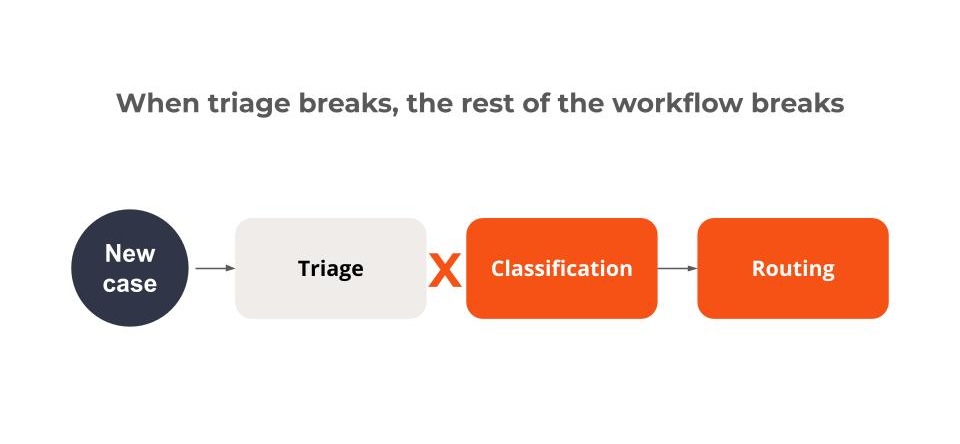
Why More Structure Doesn’t Fully Solve It
Most teams try to fix this by adding more structure.
They do things like:
- Adding required fields (oh the joy!)
- Introducing picklists
- Using AI to categorize incoming work
This helps in some cases. The data looks cleaner, and routing can rely on more consistent inputs.
But classification is not the same as triage.
Classification labels the work. Triage determines what needs to actually happen next.
Even when the label is correct, the handling can still vary. The system knows what something is called, but not necessarily what to do with it.
Why People Stay in the Loop
Because triage isn’t handled consistently, people step in.
They:
- Review incoming cases
- Adjust priorities
- Correct classifications
- Reassign work
This becomes part of the daily routine.
It’s often accepted as normal. But it’s not just “manual work.” It’s manual triage.
People are doing the part of the process the system doesn’t handle reliably on its own.
What Changes with AI and What Doesn’t
With AI and Agentforce, more of this step can be automated.
Systems can read emails, extract key details, and suggest categories or priorities. That makes triage faster and reduces manual effort, but inconsistently.
Agentforce helps understand the request, but does not control what happens because of it. That distinction matters, because once the work is classified, everything still depends on:
- how that classification is interpreted
- how routing is triggered
- what actions follow
And that’s where inconsistency shows up. Even with better classification, outcomes still vary:
- different teams handle the same case differently
- routing depends on data that may not be set yet
- follow-up actions are applied inconsistently
Triage becomes faster but stays unreliable.
In many cases, no amount of automation fixes routing problems, because the bottleneck isn’t routing.
It’s the translation from “what this is” to “what should happen”, in other words, triage.
Every case, lead, or request passes through that step, whether it’s explicit or not. If that step isn’t defined clearly and consistently, everything built on top of it inherits that inconsistency.
Before You Fix Routing, Fix Triage
You can’t route work reliably if the system doesn’t understand what it is. And that understanding comes from triage.
Before routing rules can be improved, before automation can scale, and before agents can operate effectively, triage has to be handled in a consistent way. Otherwise, routing will continue to look like the problem. In reality, routing is just where the problem becomes visible.
Interested in making your workflow execution more consistent? Let’s talk.
Related insights
How to improve Salesforce case deflection rates
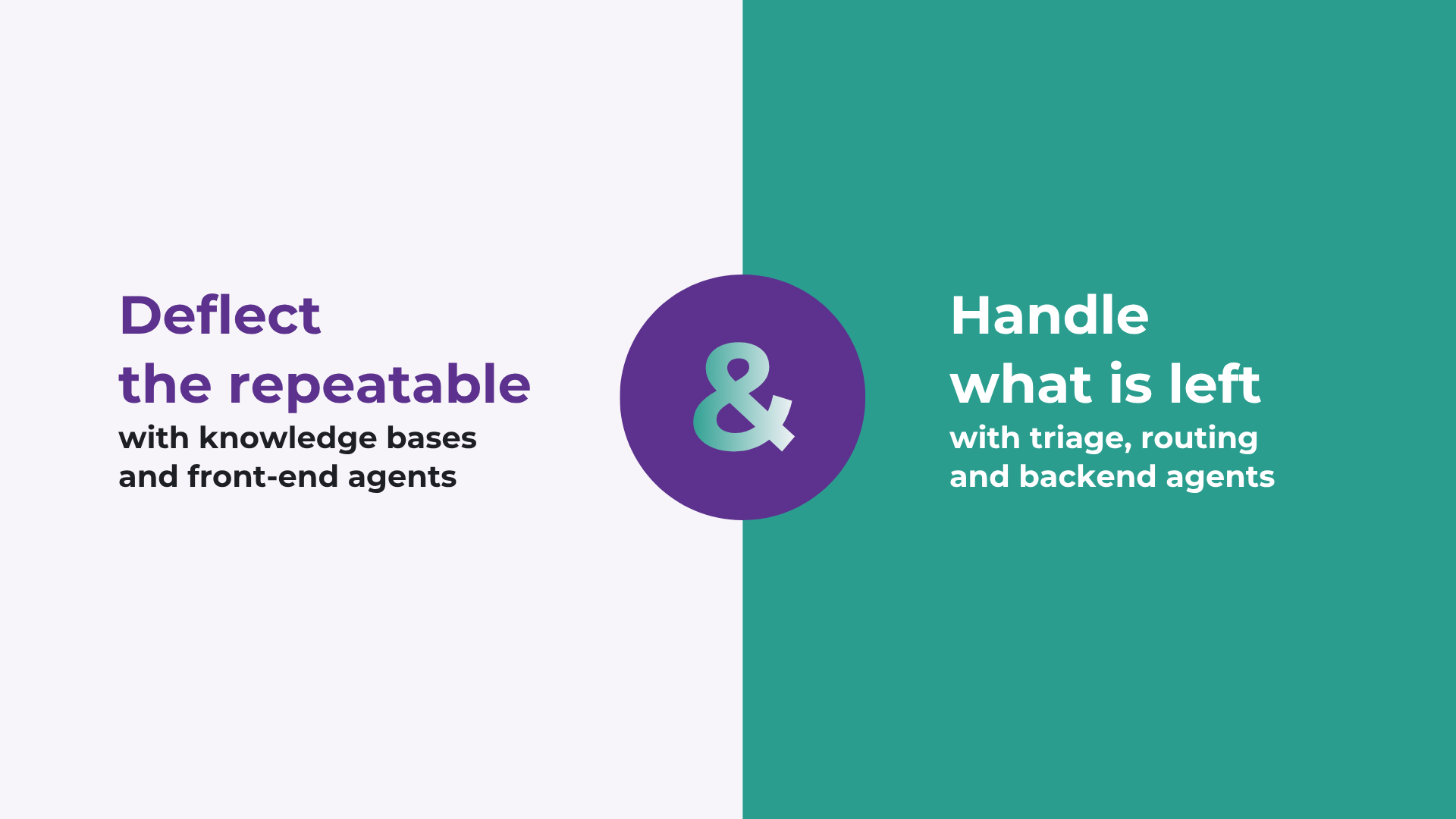
Deflection only solves half the problem. The cases that do not deflect are the ones that breach SLA. How to improve deflection rates, and how to handle what is left.

Calling Salesforce is easy. Defining what happens next is the hard part.
Salesforce workflows don’t break because of missing automation. They break because no single system defines what should happen. Here’s what actually fixes it.

Salesforce Headless 360 doesn't fix broken workflows, it exposes them.
Salesforce’s shift to Agentforce and Headless 360 makes everything callable. Without control over how work executes end to end, it simply exposes the same fragmented workflows and scales their inconsistencies.
READY TO SEE IT IN ACTION
Map your workflows with our team.
30 minutes, no prep needed. We will map one workflow you handle today and identify where orchestration would change the outcome.